Engaged Buddhism is the name Thich Nhat Hanh gave to what he and a circle of Vietnamese monastics began doing in the early 1960s in Saigon, Hue, and the villages of central Vietnam: leaving the meditation hall to rebuild bombed villages, run schools, treat the wounded, and walk between the warring sides as a third force calling for peace. Thay's argument was simple. If Buddhism teaches interbeing — that the bomb and the bombed, the soldier and the monk, are not separate phenomena — then a Buddhism that sits in the temple while the village burns has not understood its own doctrine. Engaged Buddhism is not a new tradition. It is the existing dharma applied honestly to the conditions of the twentieth century.
The seeds were already in the tradition. King Ashoka's rock edicts in the third century BCE programmed a Buddhist polity around non-violence, animal welfare, hospitals, and irrigation. The Bodhicaryavatara of Santideva put the bodhisattva's commitment to all suffering beings into its most uncompromising form. The Cambodian socialist monk Buddhadasa Bhikkhu, the Sri Lankan Sarvodaya Shramadana Movement of A. T. Ariyaratne (founded 1958, now organizing over 15,000 villages), the Indian Dalit conversion movement led by B. R. Ambedkar (1956, with 500,000+ Dalits embracing Buddhism in Nagpur as a path out of caste oppression), and the political activism of Burmese democracy leader Aung San Suu Kyi all belong to the same impulse.
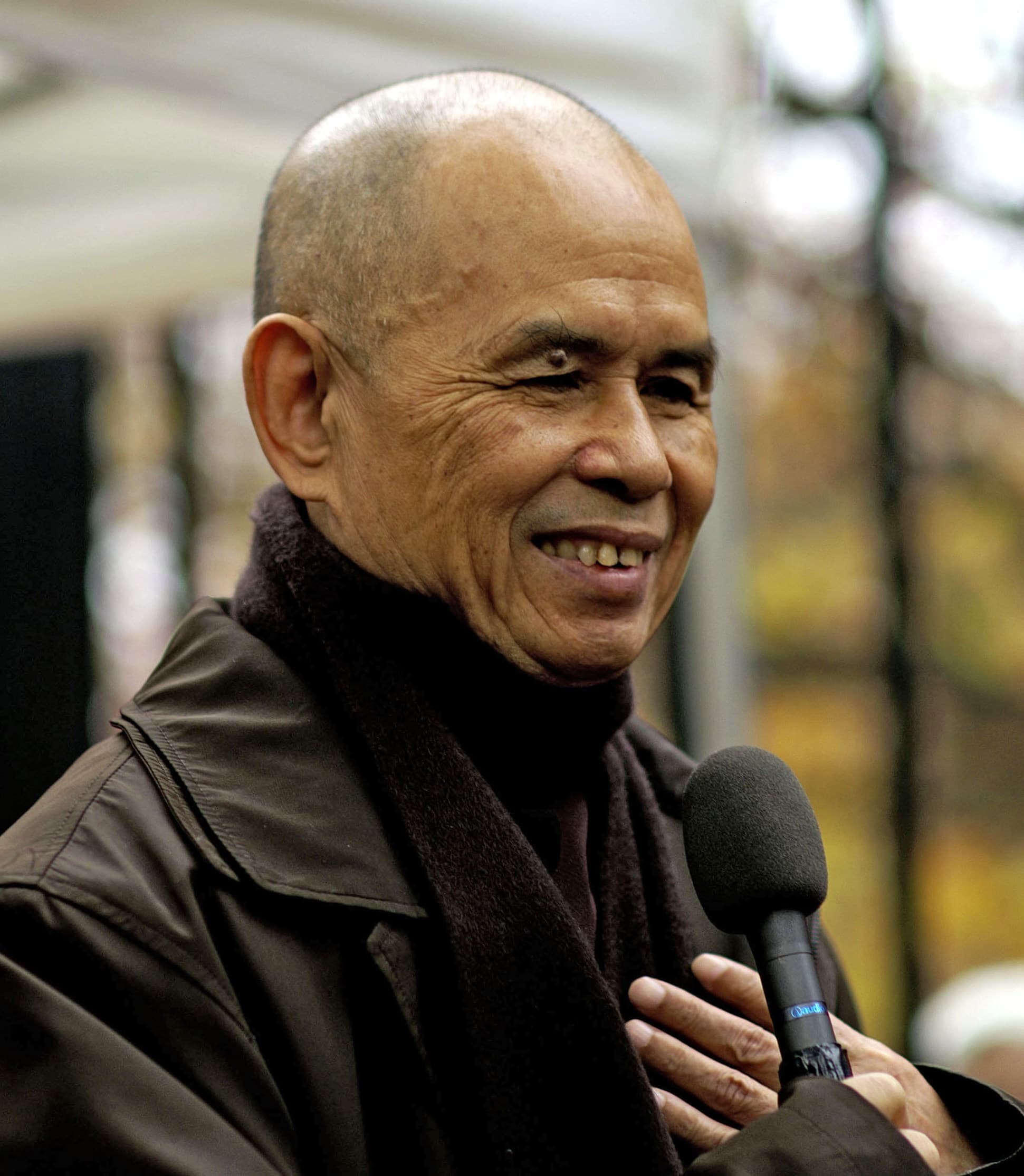
Thich Nhat Hanh (1926–2022) crystallized it. As a young monk he co-founded the School of Youth for Social Service in 1964, training thousands of young Vietnamese to do reconstruction work in villages on both sides of the war. In 1966 he came to the United States to call for an end to the conflict; Martin Luther King Jr. nominated him for the Nobel Peace Prize in 1967, calling him an apostle of peace and non-violence. Banned from returning to Vietnam by both governments, Thay went into exile in France, where in 1982 he founded Plum Village — now the largest Western Buddhist monastery, with sister centers in Germany, the United States (Magnolia Grove, Blue Cliff, Deer Park), Thailand, Hong Kong, and Australia. His Order of Interbeing (Tiep Hien), founded in 1966, articulated fourteen mindfulness trainings that update the bodhisattva precepts for engaged practice. Thay's books — Being Peace, Peace Is Every Step, The Miracle of Mindfulness, Living Buddha, Living Christ — sold tens of millions of copies and seeded mindfulness practice across Western secular institutions including hospitals, schools, prisons, the World Bank, the U.S. Congress, and Google.
The movement is broader than any single teacher. The International Network of Engaged Buddhists (INEB), founded by Sulak Sivaraksa in 1989 in Thailand, has linked engaged Buddhist communities across more than thirty countries. Bernie Glassman's Zen Peacemakers, founded in 1996, runs Bearing Witness retreats at Auschwitz and homeless street retreats in U.S. cities. The Buddhist Peace Fellowship (1978, U.S.) organizes around prisons, gender justice, and racial equity. Joanna Macy's Work That Reconnects has translated Buddhist insight into a curriculum for ecological grief and resilience. Aitken Roshi, Christopher Titmuss, Stephen Batchelor, Joan Halifax, bell hooks, and angel Kyodo williams have each carried different facets of the engaged ethic into Western practice communities. In Asia, the Tzu Chi Foundation of Taiwan — founded by the Dharma Master Cheng Yen in 1966, the same year as the Order of Interbeing — has built one of the largest Buddhist humanitarian organizations in history, with hospitals, disaster relief, recycling networks, and operations in over 100 countries, expressing a Mahayana lay-engaged Buddhism rooted in Pure Land devotion.
The distinguishing features of Engaged Buddhism are these. It is non-violent without being passive. It treats the meditative interior and the social exterior as a single field of practice; one cannot end suffering in the heart while ignoring suffering in the street. It is interfaith-fluent, often working with Catholic Workers, Mennonite peace teams, Jewish renewal communities, and Hindu Gandhian movements. It is institutionally light — usually networked rather than hierarchical, and it tends to ordain women and laypeople into roles that more conservative monastic traditions reserve for men. And it carries a particular ecological burden: in a century of climate breakdown, Engaged Buddhism is positioning the bodhisattva vow as a vow to the biosphere itself.
Thich Nhat Hanh, when asked late in life what he would do if he were a young monk today, said simply: I would do exactly what I did before. The dharma is not separate from the world. To practice it is to enter the world without flinching, to breathe, to smile, and to act.