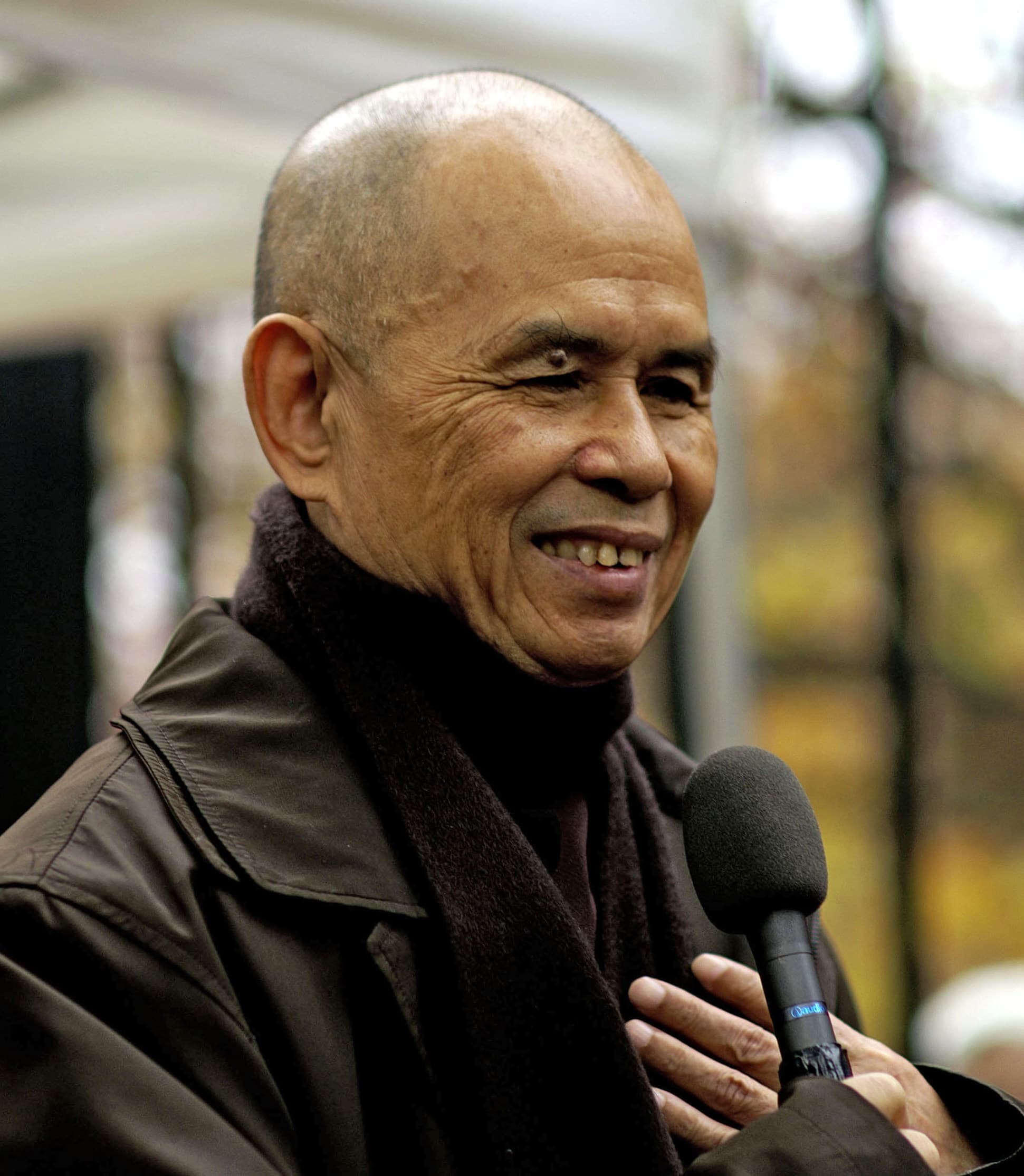
He was born Nguyễn Xuân Bảo on October 11, 1926, in the village of Hue in central Vietnam, the second son of a French-educated civil servant of the Nguyễn dynasty. He saw a photograph of the Buddha in a magazine when he was seven and decided, the autobiographical Fragrant Palm Leaves records, that he would become a monk. He entered Tu Hieu pagoda in Hue as a novice at sixteen under the Lieu Quan lineage of Vietnamese Thien (Zen, descending from the Chinese Linji school). He took full ordination at twenty-three and the dharma name Thich Nhat Hanh — "One Action," from the Vietnamese reading of the Chinese 一行.
Vietnam, when he came of age in the late 1940s and 1950s, was a country at war with itself and successive empires — first the French, then the Americans, then internally, North against South. Thich Nhat Hanh's response was to attempt to make Buddhism speak to the conditions of war. In 1961 he came to the United States to study comparative religion at Princeton; in 1963 he taught at Columbia; in 1964 he returned to Saigon. The Buddhist Crisis of that year had brought down the Diem regime; the Sangha was now visible in Vietnamese politics. Thich Nhat Hanh founded the School of Youth for Social Service — a corps of young Buddhists, trained in dharma practice and in practical skills, who went into villages destroyed by the war to rebuild homes, set up schools, and care for orphans, without taking sides. He coined the term Đạo Bụt dấn thân — "engaged Buddhism" — to describe what they did: the dharma as social action, the meditation cushion and the village street as a single practice. He founded La Boi Press, the most influential Vietnamese Buddhist publisher of the period, and Vạn Hạnh Buddhist University. By the mid-1960s, he was the most visible Buddhist intellectual in South Vietnam.
In 1966 he came again to the United States to speak against the war. He met Martin Luther King Jr. in Chicago. King, the following year, nominated him for the Nobel Peace Prize with the citation: "I do not personally know of anyone more worthy of this prize than this gentle monk from Vietnam." The Nobel committee, controversially, awarded no peace prize that year. South Vietnam and North Vietnam each refused to allow Thich Nhat Hanh to return. He was thirty-nine; he would not see his home country again for thirty-nine years.
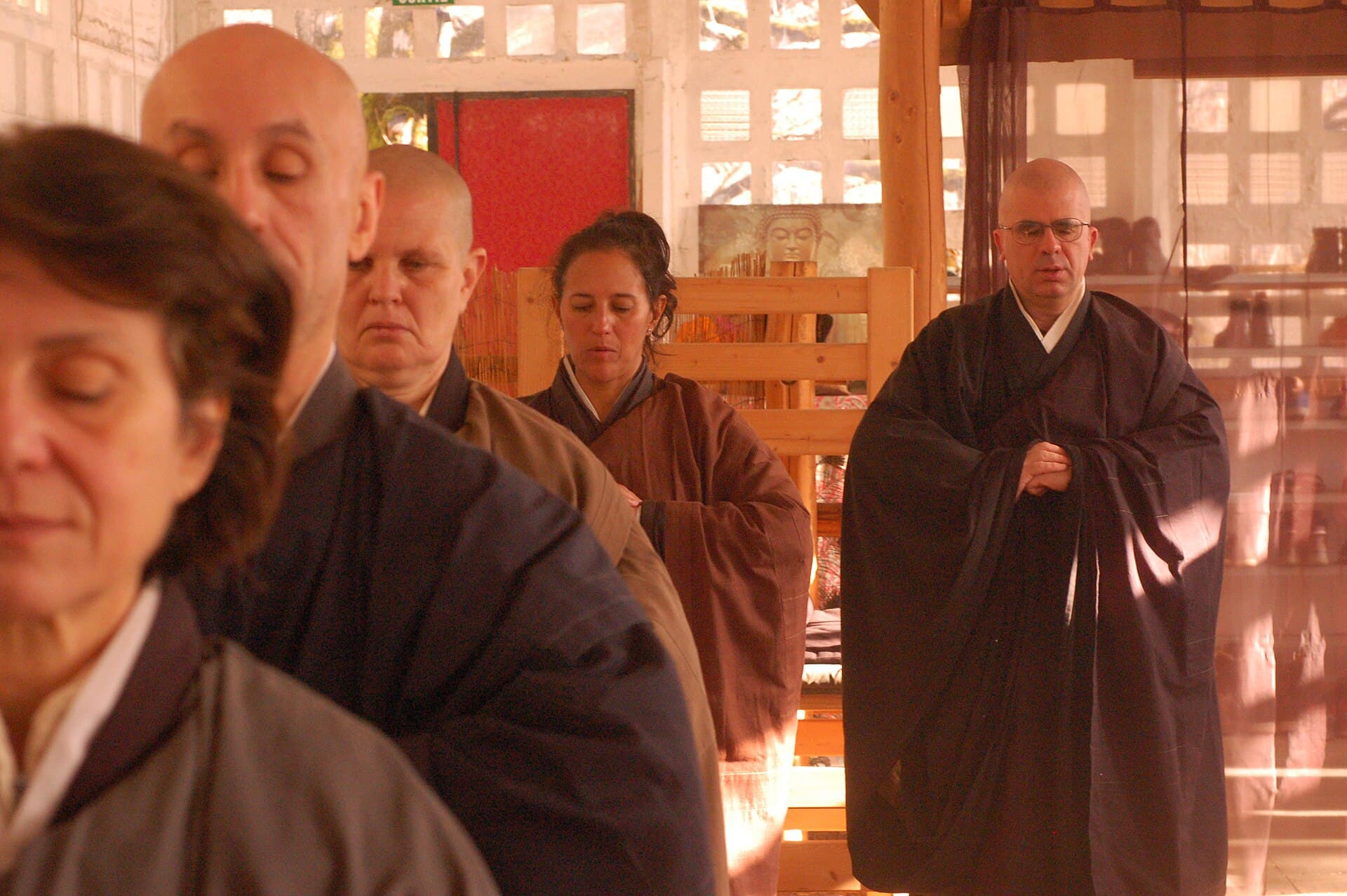
The exile was the second life. He settled in France, established the Sweet Potato Community in 1975 and, in 1982, Plum Village in the Dordogne in southwest France. The community grew slowly at first — a few monastics, retreatants, the children of Vietnamese boat refugees. By the mid-1990s, it was the largest dharma community in the West outside Tibetan diasporic centers. Plum Village now has affiliated practice centers in Vermont (Maple Forest), New York (Blue Cliff), Mississippi (Magnolia Grove), Germany (European Institute of Applied Buddhism), Thailand, Australia, and Hong Kong. The Plum Village tradition — sometimes called the Order of Interbeing — combines Vietnamese Zen, mindfulness practice, the Bodhisattva precepts, gathas (short verses chanted before activities), walking meditation, and total community life. The Fourteen Mindfulness Trainings of the Order of Interbeing, which Thich Nhat Hanh composed in 1966, are the formal precepts. They include the line: "Do not be idolatrous about or bound to any doctrine, theory, or ideology, even Buddhist ones."
His literary output was unparalleled in the modern dharma. He wrote in Vietnamese, English, and French and authored more than a hundred books, including The Miracle of Mindfulness (1975 — written as a long letter to his students still in Vietnam under postwar pressure), Old Path White Clouds (1991 — a long-form biography of the Buddha drawn from the Pali and Sanskrit sources), Peace Is Every Step (1991), Living Buddha, Living Christ (1995), The Heart of the Buddha's Teaching (1998), Anger (2001), No Death, No Fear (2002), and The Other Shore (2017 — his commentary on the Heart Sutra). His translation of the Heart Sutra, which substitutes "interbeing" for "emptiness" in much of the rendering, has been controversial among scholars and beloved among practitioners.
He returned to Vietnam for the first time in 2005, at the invitation of the Vietnamese government and after long negotiation. The two subsequent visits were difficult; the government tolerated him with increasing reluctance. He suffered a severe stroke in November 2014 that left him largely without speech for the remainder of his life. In 2018, he returned permanently to Tu Hieu pagoda — the temple where, at sixteen, he had taken novice ordination — and asked to be allowed to die there. He died at Tu Hieu on January 22, 2022, at the age of ninety-five.
He is the figure who most successfully translated the contemplative tradition into the social vocabulary of the late twentieth century. The phrase "mindfulness" as a global practice category, the modern hospice movement's use of dharma framings for the death process, the integration of meditation into medical and corporate settings, and the very category of "engaged Buddhism" all run through him. He is also the bridge between East Asian Zen and Western practice culture, and a moral figure whose refusal — through forty years of exile — to take sides in his own country's war is itself a teaching the tradition has not yet finished receiving.