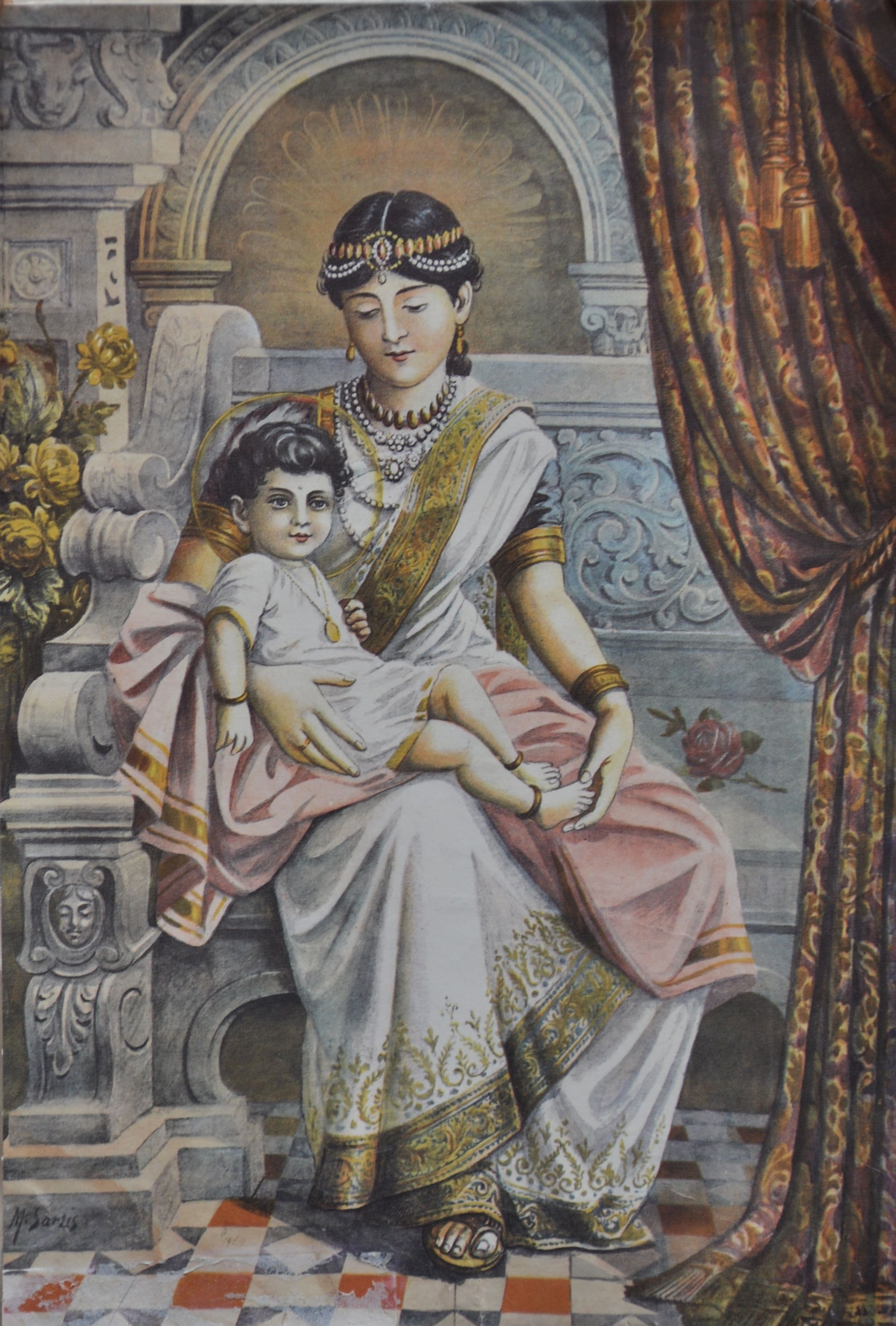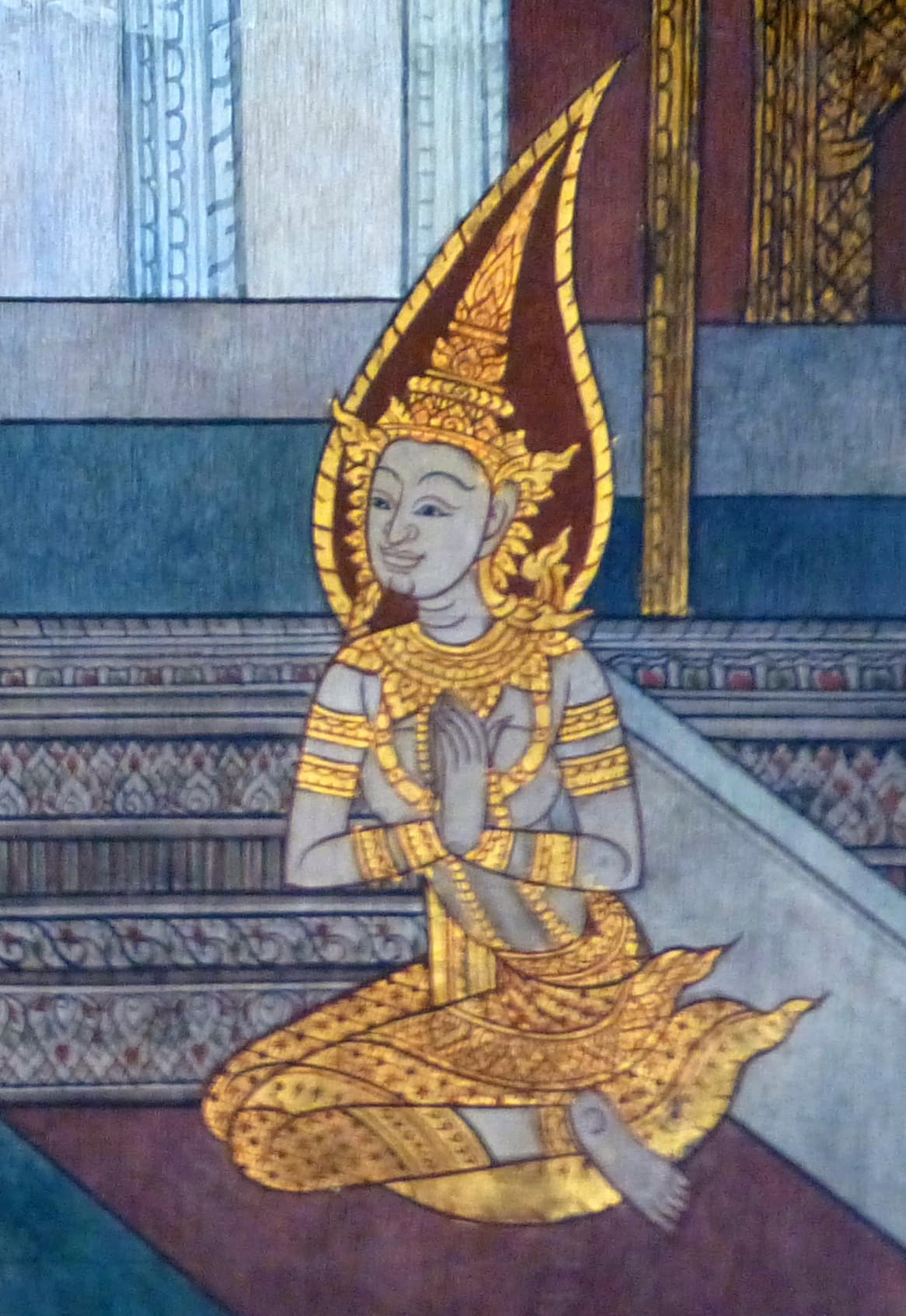
Her name in the Pali sources is Yasodharā or, more often, Bhaddakaccāna or Rāhulamātā — "Rahula's mother." The Sanskrit tradition prefers Yaśodharā. She was born on the same day as Siddhartha, the Lalitavistara records — one of the seven beings whose birth coincided with his, the others being Ananda, the Bodhi tree, the horse Kanthaka, the charioteer Channa, and a hidden treasure. Her father was Suppabuddha of the Koliyas; her mother Pamita was Suddhodana's sister. She was therefore Siddhartha's first cousin on both sides, and the marriage — at sixteen, the texts say — was a Shakya-Koliya alliance of the standard kind.
The years in the palace are sketched only in the legend. She is the figure beside him in the picture of the perfect princely life: three palaces, dancing women, the lotus pond. She gave birth to Rahula on the night of the great renunciation itself — the name, "fetter," is recorded as Siddhartha's own response when he learned of the child: rāhulajāto, "a fetter is born." He came one last time to look at her sleeping with the newborn at her breast, did not wake her, and rode out of Kapilavastu before dawn.
What she did with the next six years is the part of the story the suttas almost don't tell, and the commentarial literature reconstructs with care. She refused to put on her ornaments. She refused to eat from raised seats. She took one meal a day. When she heard he was wearing yellow robes, she put on yellow. When she heard he slept on the ground, she did the same. When her father Suppabuddha proposed remarriage to another suitor, she refused. The Dhammapada-atthakatha records that when news came of his self-mortification in the forest, she stopped eating until news came that he had taken food again. She was, in effect, practicing the Shakya half of the renunciation in the palace at Kapilavastu while her husband practiced the forest half.
The Buddha returned to Kapilavastu in the second year after his awakening. The Mahavagga of the Vinaya records the visit. He went house to house begging — to Suddhodana's horror — and then dined at the palace at his father's invitation. Yashodhara did not come out to meet him. She sent word: "If I have any virtue, the lord will come to me." He went to her chamber with Sariputta and Mahamoggallana. She fell at his feet, held them, and wept. Suddhodana, watching, recounted to the Buddha the seven years of her quiet matching of his asceticism. The Buddha replied with the Candakinnara Jataka — a tale of their devotion in a previous life — and left.
She sent Rahula, then seven years old, to ask his father for his inheritance. The boy did so. The Buddha turned to Sariputta and said, "Ordain him." The royal inheritance she had sent the boy to claim turned out to be the dhamma. Suddhodana, when he heard, asked the Buddha for a new rule: that no child be ordained without parental consent. The Buddha agreed.
Yashodhara entered the bhikkhuni order five years later, when Mahaprajapati Gotami opened the way. She was ordained by Mahaprajapati and given the name Bhaddakaccāna in the Sangha — though the texts continue to call her Rahulamata. She attained arahantship rapidly. The Anguttara Nikaya (AN 1.236) places her among the foremost bhikkhunis: "preeminent in great supernormal knowledge" (mahābhiññāppattānaṃ aggā) — the bhikkhuni equivalent of Mahamoggallana, with the capacity to recollect past lives across innumerable aeons. She is said to have died, an arahant, at seventy-eight, two years before the Buddha's own parinirvana. The Apadana preserves verses attributed to her, in which she reckons that she has served the Bodhisatta in countless previous lives. The marriage of one lifetime, in her account, is the briefest fragment of an ancient companionship.
Later traditions — Sanskrit, Tibetan, and East Asian — would expand her story considerably. The Mulasarvastivada Vinaya treats her with detailed sympathy. Modern Buddhist women have made her, with reason, the patron of those whose spiritual life begins in the form of being abandoned. She is among the most carefully drawn women in the canonical record.