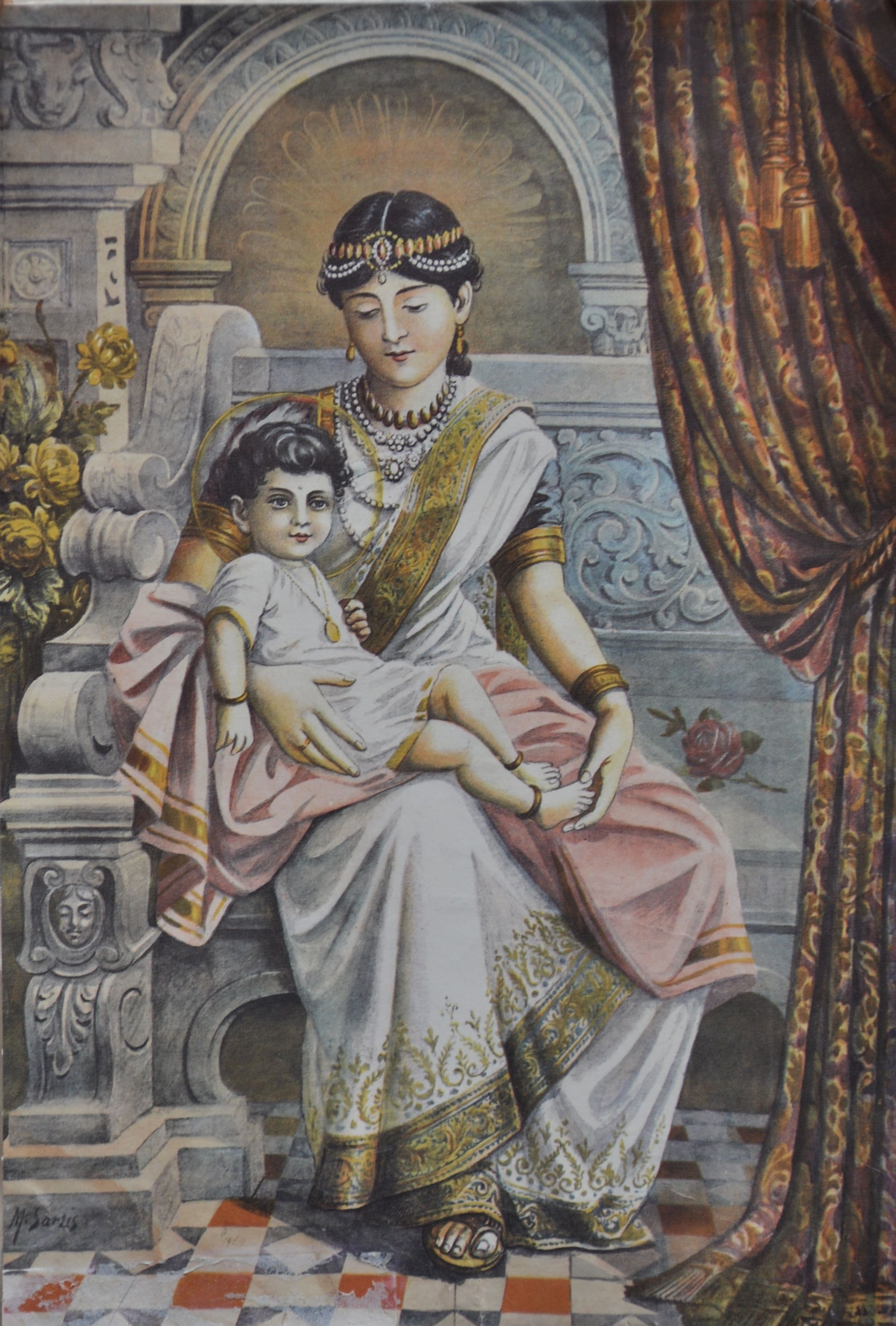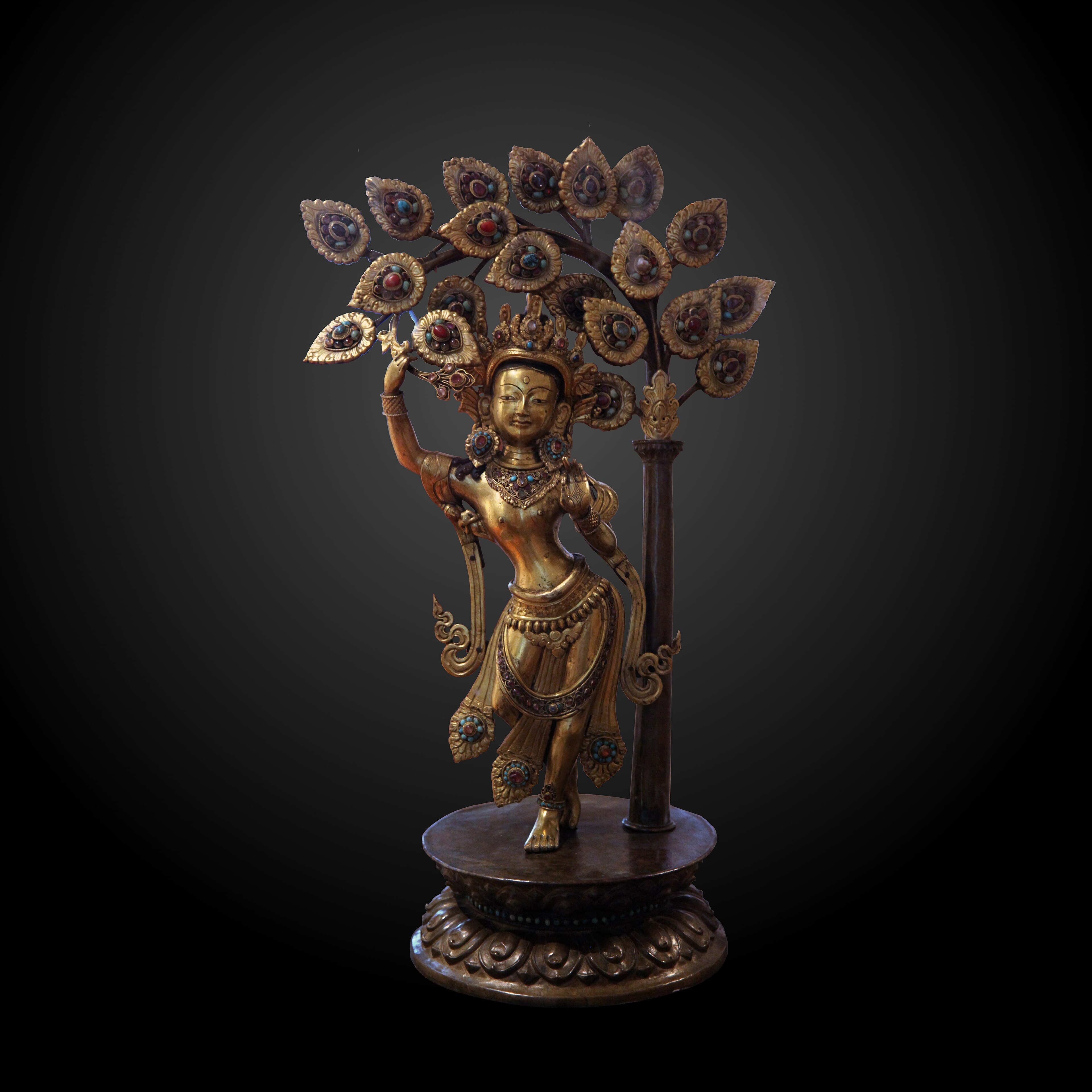
The Pali sources name her Mahāmāyā — Great Maya, "great illusion" — though the Sanskrit traditions usually call her simply Māyā or Mayadevi. She was the daughter of Añjana, king of the Koliyas at Devadaha, and the wife of Suddhodana, raja of the Shakya republic at Kapilavastu. The two clans were neighbors on the Rohini river; both claimed descent from the same ancient line, and intermarried generation after generation. She was, in the way of these things, a cousin to her husband.
The canonical biography of her son begins with her. The Acchariya-abbhuta Sutta (MN 123) records what the bhikkhus called the wonderful and marvelous qualities of the Tathagata's coming. While she was carrying the future Buddha, the sutta says, four guardian deities watched over her, no thought of sensuality arose in her, no bodily pain. She saw the child within her like a thread of many-colored gemstone strung through clear crystal. She decided, in the way Shakya custom required, to return to her parents' house in Devadaha to give birth.
On the way north, in the tenth month of her pregnancy, the procession halted at the Lumbini sal grove, halfway between Kapilavastu and Devadaha. The Nidanakatha — the introductory portion of the Jataka commentary — records that she stepped down from her palanquin to walk among the flowering trees, reached up for a branch of a sal tree, and the child was born, painlessly, from her side, in the standing posture. He took seven steps to the north, lotuses springing up where his feet touched. He raised his right hand and said: "I am the chief in the world, the eldest in the world, the foremost in the world. This is my last birth." Or so the tradition records. The Lumbini pillar, raised by Ashoka two and a half centuries later, marks the spot to the foot.
She died seven days after the birth. The texts give no cause and the commentaries treat the timing as iron necessity: the womb that has borne a Buddha cannot be used for anything else, must not be defiled by ordinary use afterward, and the mother of a Buddha — by the working out of past kamma — dies within a week of giving birth and is reborn in the Tushita heaven. Her sister Mahaprajapati Gotami, also married to Suddhodana, became the infant's wet nurse and, in time, his mother in the only sense he would know.
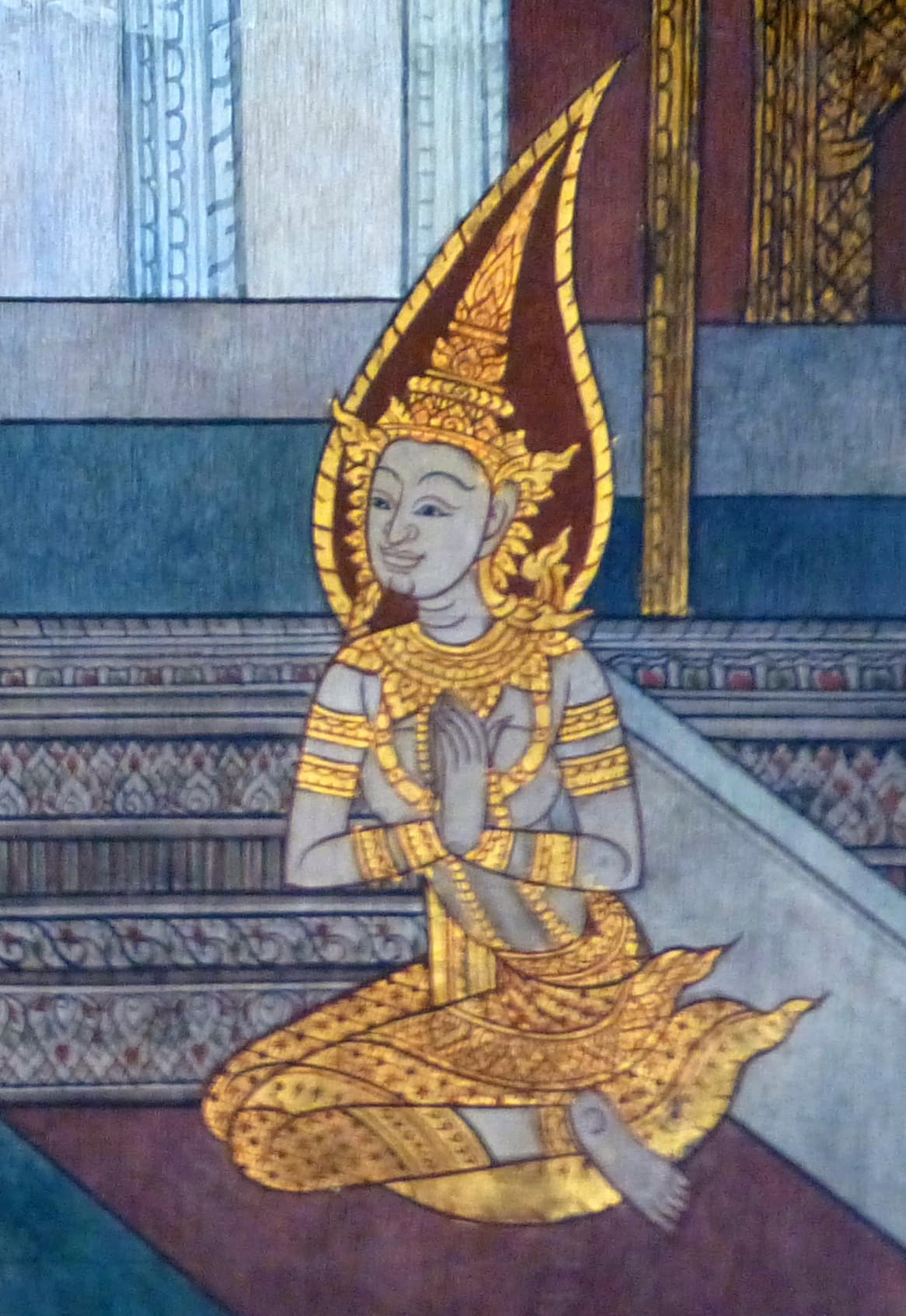
The most extraordinary thing about Mayadevi in the canonical record happens not at the birth but thirty-five years later. In his seventh rains retreat after awakening, the tradition records, the Buddha ascended to the Tavatimsa heaven — not Tushita but the realm immediately below — and there taught the Abhidhamma, the higher doctrine, for three months continuously to the assembly of devas, with his mother seated before him. Some versions place her in the audience as a deva named Santusita, the Tushita deity she had become; she descended to Tavatimsa to hear her son teach. At the end of the rains, the Buddha descended back to earth at Sankisa on a triple stairway of gold, silver, and crystal. The site is one of the eight great pilgrimage places. The teaching itself — the Abhidhamma in its seven books — was repeated to Sariputta on the daily descents and from him entered the canon.
That the mother of a Buddha must die within seven days; that the Abhidhamma was first taught to her in the deva realm; that the texts surround her birth and death with omens, dreams, white elephants, and floral marvels — none of this is history in the ordinary sense. The historical Mayadevi was a Koliya princess who died of postpartum complications in 563 BCE on the road home to her father. What the tradition makes of her is a doctrine: that the body of a Buddha enters the world through a perfect vehicle, and that even the human relations the Buddha leaves behind are not lost in the dhamma but transfigured by it. The Mayadevi temple at Lumbini, with the marker stone said to fix the exact spot of the birth, has been a pilgrimage site since at least the third century BCE. She is the first figure in the entire dharmic record.