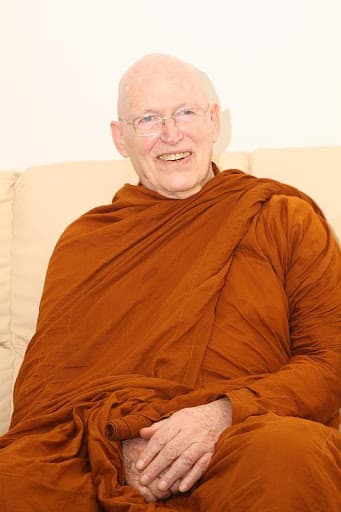
He was born Robert Jackman in Seattle in 1934. He served in the US Navy during the Korean War, completed a BA in Far Eastern studies at the University of Washington, and went to Borneo with the Peace Corps. In Malaysia in 1966 he encountered Buddhism in earnest and travelled to Thailand the following year. He took novice ordination at Wat Sri Saket in Nong Khai and full bhikkhu ordination later that year, and in 1967 met Ajahn Chah at Wat Pah Pong. He stayed ten years.
The early years were not easy. He spoke no Thai when he arrived; the monastery was extremely strict; Ajahn Chah made it a point not to give Western monks special treatment. He was given the same tasks as the village boys who had been ordained — sweeping the forest, doing alms-round in the rain, sleeping in the cremation forest — and the same instruction, which was to find out for himself. He has often told the story of the moment he understood his teacher: at three in the morning, in his hut, in tears, the question "What is this?" arose, and the silence around the question was the answer.
In 1975 he was made the founding abbot of Wat Pah Nanachat, the international forest monastery Ajahn Chah established for Western students. In 1976 he was invited by the English Sangha Trust to come to London. In 1977 he arrived at the Hampstead Vihara in north London — a small flat, four monks, an English winter — and the Thai forest tradition was for the first time settled in the West.
In 1979 the trust offered him an abandoned forest in West Sussex. He walked into it with three other monks; they slept in tents and built a small monastery from scratch. This became Chithurst Buddhist Monastery, the first forest monastery in England. In 1984 the Trust acquired a larger property in the Chiltern Hills and Ajahn Sumedho founded Amaravati Buddhist Monastery, which has remained the central English monastery of the Forest Sangha and where the senior bhikshunis of the lineage now train.
Through him the lineage spread further. Ajahn Pasanno was sent to California to found Abhayagiri Monastery. Ajahn Brahmavamso founded Bodhinyana Monastery near Perth. Ajahn Munindo led Aruna Ratanagiri in Northumberland. Italian, German, Swiss, and New Zealand branches followed.
His own teaching has hewed closely to the simple emphasis Ajahn Chah gave him: that suffering is to be understood, not gotten rid of; that the path is not somewhere else, that the path is here. His most-quoted formula — "I am at peace with the way it is" — is meant not as resignation but as the precise practice of the third noble truth, the cessation that is found in the recognition.