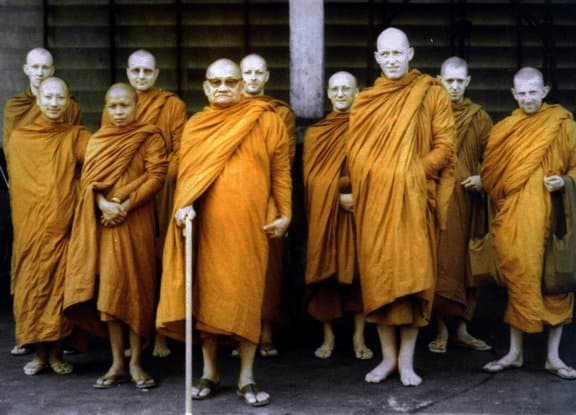
He was born Chah Phothiyan in 1918 in a small village in Ubon Ratchathani province in northeast Thailand, to a farming family. He was ordained as a novice at nine, returned to lay life to help his family at thirteen, and was ordained again as a bhikkhu at twenty in 1939. After several years of conventional monastic study he became dissatisfied with the village wat system — too much ceremony, too little practice — and took up the dhutanga life of the wandering forest monk.
He walked across Thailand for years, sleeping under trees, eating one meal a day, owning only the eight requisites a Theravada monk is permitted. In 1946 he sought out Ajahn Mun Bhuridatta in the forests of Sakon Nakhon — the master of the Thai forest revival, one of the great practitioners of the twentieth-century Theravada — and stayed only three days. Ajahn Chah later said it was enough; Mun gave him the essential instruction, that the Pali Canon is "a finger pointing at the moon, not the moon itself," and that the only place practice happens is in the body and mind right now.
In 1954 he returned to the forest near his birth village and a small group of villagers offered him a piece of land. The monastery he established there, Wat Pah Pong, became the model for what is now a network of over three hundred forest monasteries across Thailand and abroad. He insisted on the original Vinaya discipline — celibacy, no money, one meal a day, robes made from cloth no one wanted — combined with intensive samatha and vipassana practice in the forest setting.
In 1966 Robert Jackman, a young American Vietnam-era expatriate, arrived at Wat Pah Pong and was ordained as Ajahn Sumedho. He became the first of a long line of Western students. In 1975, recognizing that Westerners needed a monastery where Pali instruction and discipline could be conducted in English, Ajahn Chah established Wat Pah Nanachat — the International Forest Monastery — under Ajahn Sumedho's direction. From it the entire Western Theravada forest tradition issues: Ajahn Sumedho founded Amaravati and Chithurst in England; Ajahn Brahm founded Bodhinyana in Australia; Ajahn Pasanno founded Abhayagiri in California; Ajahn Jayasaro is now a senior teacher in Thailand.
Ajahn Chah's teaching style was conversational, often parable-driven, and almost entirely oral; he wrote nothing himself. His talks were transcribed and translated by Western monks who lived near him, and collected in volumes including A Still Forest Pool, Food for the Heart, and the Collected Teachings. The style is recognizable: direct, often startling, almost never abstract. He would point at the floor and say "Where is your mind?" He would compare the mind to a glass: "Drink the water, taste it; we don't need to explain the chemistry of water."
He suffered a debilitating stroke in 1981 and lived for another eleven years in declining health, mostly unable to speak. His students continued to visit him to "take refuge in him on the cushion" as one of them wrote. He died at Wat Pah Pong on the sixteenth of January 1992. His funeral was attended by one million people. The Thai government issued a commemorative coin.