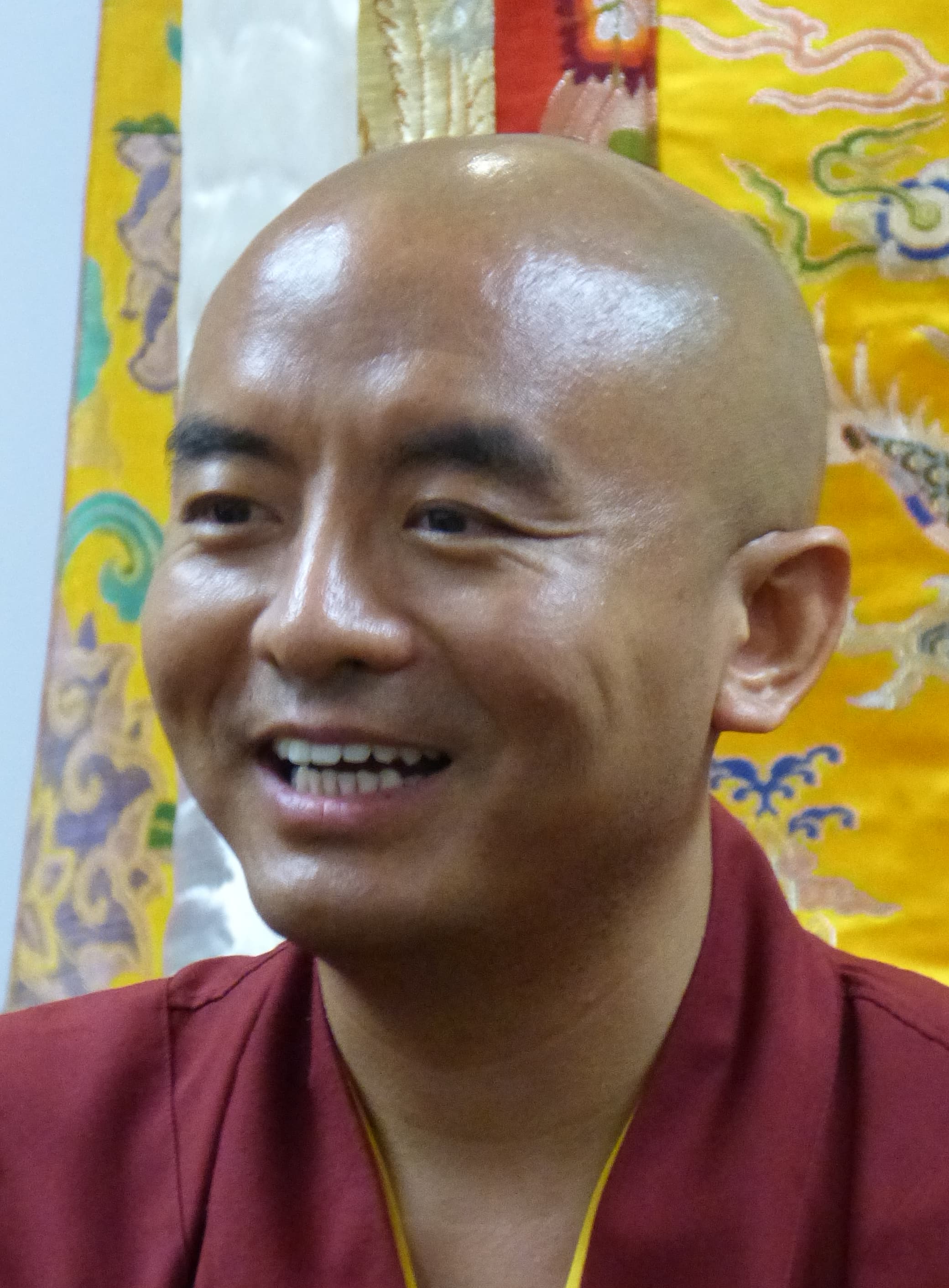
He was born in 1975 in Nubri, a high Himalayan valley in Nepal near the Tibetan border, to Tulku Urgyen Rinpoche, the great Nyingma Dzogchen master, and Sönam Chödrön. His father was the teacher Pema Chödrön would have called "the lineage." His mother was a daughter of the Nubri valley. He is the youngest of four brothers, all of whom became recognized tulkus — including Tsoknyi Rinpoche and Chökyi Nyima Rinpoche, the abbot of Ka-Nying Shedrub Ling in Boudhanath. The family is the central Nepali node of contemporary Tibetan Buddhism.
Recognized at the age of three as the seventh incarnation of Yongey Mingyur Rinpoche, a Kagyu/Nyingma master in the line of the Karmapas, he was sent for formal monastic education to Sherab Ling in Bir, India, the seat of the Twelfth Tai Situ Rinpoche. He completed his first three-year retreat at thirteen — making him one of the youngest retreatants in living memory of the tradition — and was made the retreat master of the next three-year retreat at the age of seventeen. He studied dzogchen with his father and Mahamudra with Tai Situ Rinpoche and Saljay Rinpoche.
He is unusual among Tibetan masters in two ways. First: he has spoken publicly and at length about the panic attacks he experienced as a child and adolescent in the mountains around his home village — described in The Joy of Living — and about how his early meditation practice was, in effect, an attempt to treat that anxiety. The book has become one of the most-read introductions to Tibetan meditation in English. Second: in 2002 he began participating in studies at the University of Wisconsin–Madison under Richard Davidson. The fMRI scans of his brain during compassion meditation showed gamma-band activity at intensities never previously recorded — the data has been the cornerstone of two decades of neuroscience research on long-term meditators.
In 2011, at the age of thirty-six, he left his monastery in the middle of the night and disappeared. He had told no one. He spent four and a half years on the road as an itinerant yogi, walking through the Indian and Nepali sacred geography, sleeping in caves and cremation grounds, owning nothing, doing the classical Vajrayana practice of becoming wholly anonymous in order to confront the death of the constructed self. The journey is the subject of In Love with the World (2019), the most directly autobiographical book he has written. At one point on the journey he contracted food poisoning so severe he nearly died, in a small town in northern India where no one knew who he was; the recognition of his own near-death and the equanimity that emerged from it is the centre of the book.
He returned to Tergar in 2015. The Tergar Meditation Community he founded has practice centres on six continents and a worldwide online sangha. His teaching style integrates traditional Tibetan instruction with modern psychology and neuroscience in a way that has made him one of the most accessible Vajrayana teachers in the world.