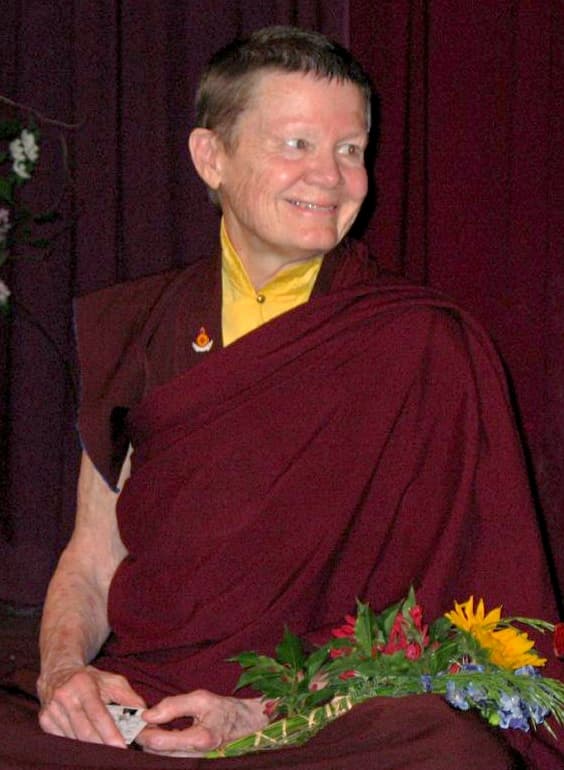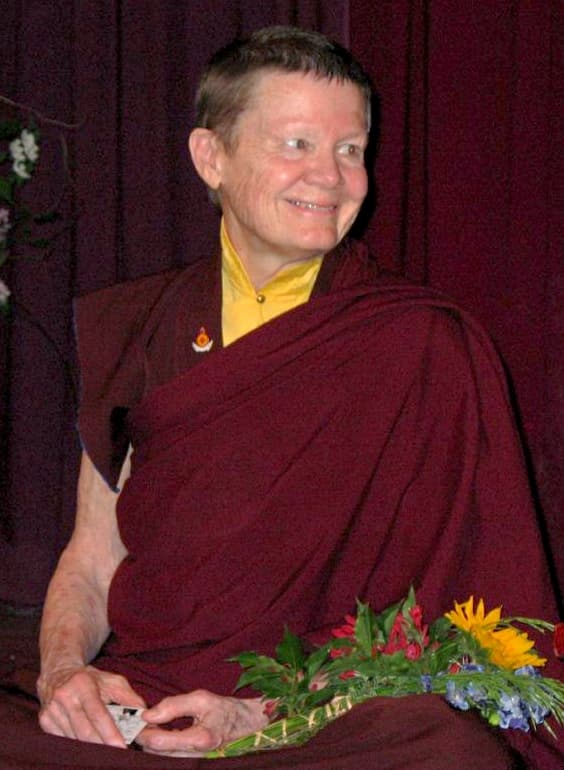
She was born Deirdre Blomfield-Brown in New York City in 1936, raised in New Jersey, educated at Miss Porter's School and the University of California, Berkeley. She taught elementary school, married twice, raised two children, and was in her mid-thirties when her second marriage ended. She has often said in interviews that the day her husband told her, on the steps of their house in New Mexico, that he was leaving her for another woman was the day her practice life began — not because she had wisdom about it but because she had nothing else.
She encountered Lama Chimé Rinpoche of the Karma Kagyu tradition in 1972 in the French Alps, and took ordination as a novice nun under him in 1974. She met Chögyam Trungpa Rinpoche, the founder of Shambhala and one of the most controversial Tibetan teachers to come to the West, in 1974 in San Francisco; she became his student that year and remained so until his death in 1987. In 1981 she took full bhikshuni ordination — a rare achievement for a Western woman, requiring travel to Hong Kong because the Tibetan tradition had not preserved the female ordination lineage.
In 1984, Trungpa Rinpoche asked her to establish Gampo Abbey on Cape Breton Island in Nova Scotia — the first Tibetan Buddhist monastery for Westerners in North America. She has been its resident teacher ever since, and was named acharya — senior teacher of Shambhala — by Trungpa's son and successor Sakyong Mipham Rinpoche in 1993.
Her teaching has a single recognizable centre: the instruction to stay. To stay with the body when the body is restless. To stay with the breath when the breath is short. To stay with the heart when the heart is broken. To stay with the relationship, the loss, the rage, the embarrassment, the fear of failure, the fear of one's own mind, long enough to see what is actually happening, which is almost always not what one feared. The practice she most consistently teaches is tonglen — the Mahayana method of breathing in suffering and breathing out relief — which she has called the practice that "blasts open the heart that has been closed for protection."
Her books — When Things Fall Apart (1997), Start Where You Are (1994), The Places That Scare You (2001), When You're Falling, Dive (2018) — have sold many millions of copies, and have brought the language of Tibetan Buddhism, especially the lojong slogans of Atisha and Chekawa, into ordinary American life. She has the unusual property among contemporary Buddhist teachers of being equally trusted by serious dharma practitioners and by readers who have never heard of the Four Noble Truths.
In 2020, in her eighty-fourth year, she resigned her teaching role within the formal Shambhala organization following the abuse allegations against Sakyong Mipham Rinpoche. She continues to teach independently from Gampo Abbey. Her position throughout that crisis — that the dharma is not the teacher, that practice is not the institution, that betrayal is itself something to be stayed with rather than fled from — has been instructive in a way no book of hers ever was.