In the canonical formulations of the Buddha's teaching, the cause of dukkha is given in several equivalent ways. The Second Noble Truth identifies craving (tanha). The chain of dependent origination begins with ignorance (avijja). The Abhidhamma traces the unwholesome roots (akusala-mula) of every defiled mental state. All three converge on the same triad: greed, hatred, and delusion. The Pali Suttas refer to them as the akusala-mūla — unwholesome roots — and the Mahayana commentary identifies them as the three klesa-mulas at the heart of samsara.
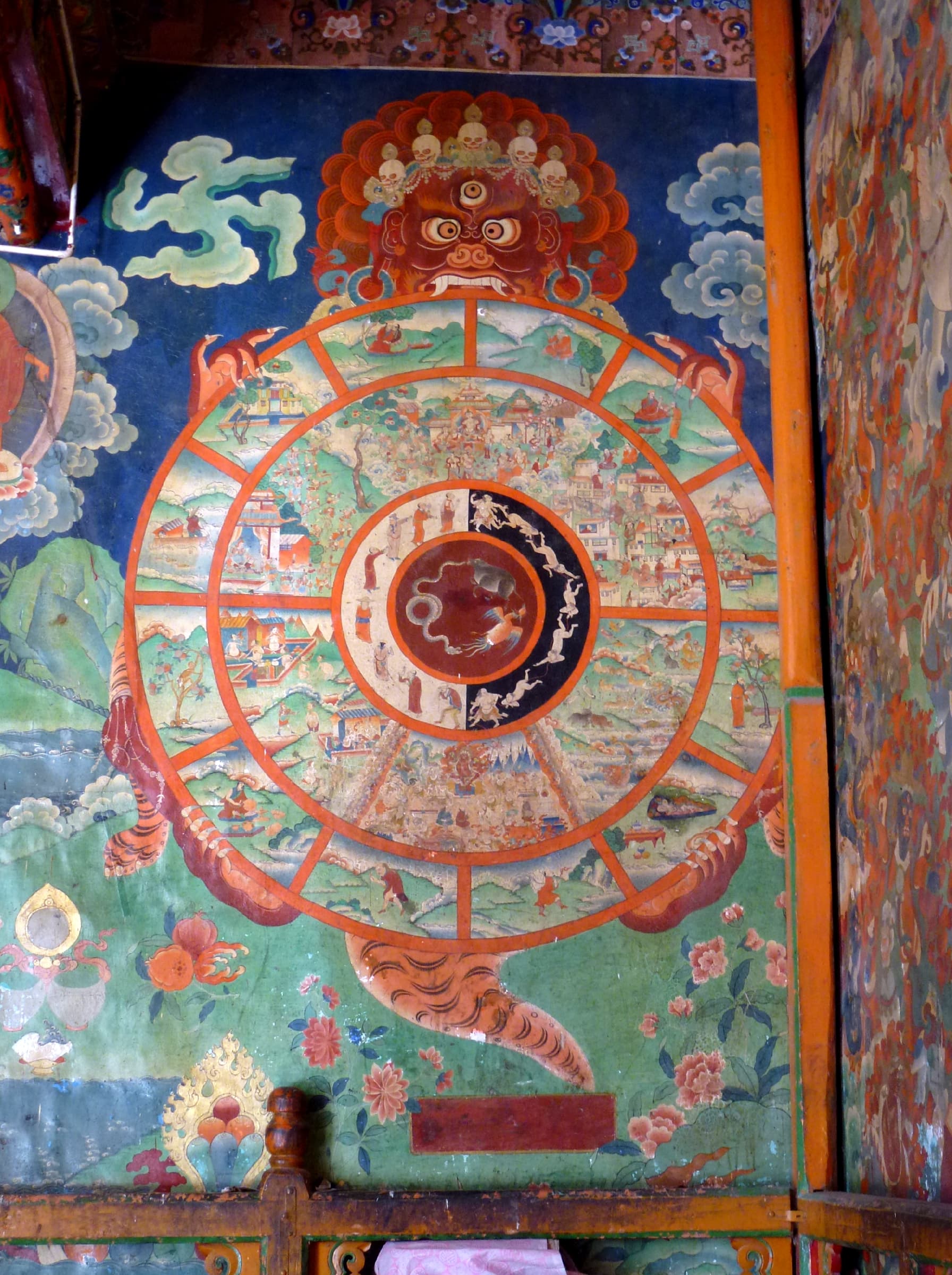
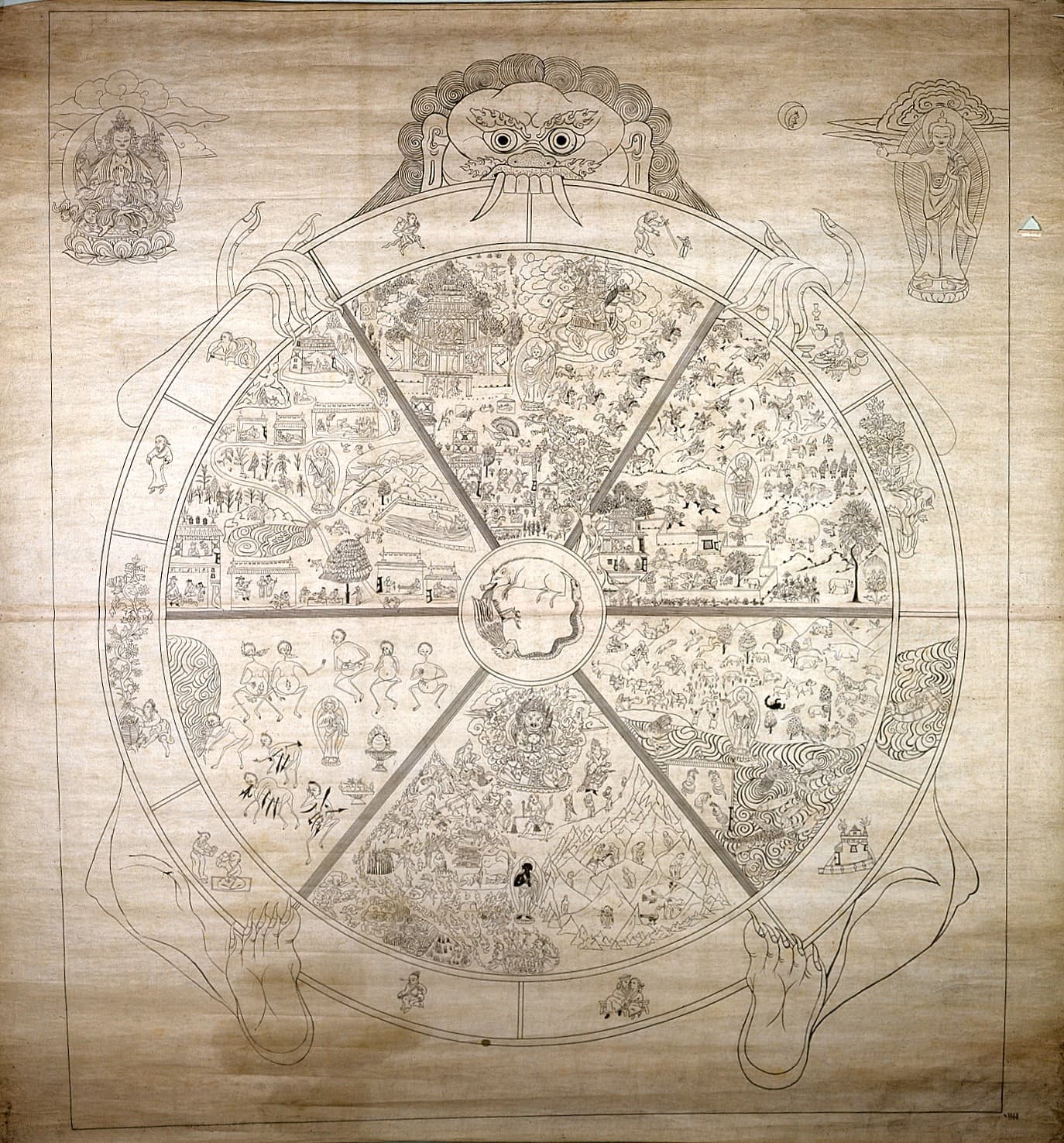
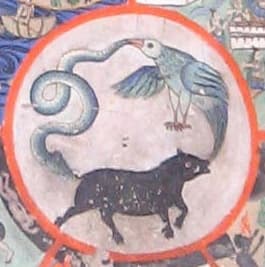
In the Tibetan tradition, the centre of the Wheel of Life — the bhavachakra painting taught in every Tibetan monastery — depicts the three poisons as a pig (delusion), a snake (hatred), and a rooster (greed), each biting the tail of the next. The image is exact: the three poisons feed one another. Delusion — the basic non-seeing of how things actually are, of impermanence and non-self — produces the misperception that some objects will deliver lasting satisfaction (greed) and that others must be eliminated to protect that satisfaction (hatred). Greed and hatred reinforce delusion by constantly reorienting attention toward objects of pursuit and avoidance, so that the seeing of how things actually are becomes harder.
The first poison, lobha or raga, covers the whole range from coarse craving to the subtlest grasping. The Pali sources distinguish kama-tanha (craving for sense-pleasure), bhava-tanha (craving for continued existence), and vibhava-tanha (craving for non-existence — the desire to be rid of what is, which the Buddha understood as another form of craving, not its opposite). Greed in this technical sense is not only the wanting of more but the wanting of any condition other than what is.
The second poison, dvesa or dosa, encompasses anger, hatred, ill-will, resentment, aversion, contempt. The Visuddhimagga compares it to a flame: it burns the one who holds it before it burns its object. The classical antidotes are metta and karuna — the deliberate cultivation of loving-kindness and compassion in their place. Shantideva's sixth chapter of the Bodhicaryavatara contains the most thorough Buddhist analysis of anger and its antidotes ever produced.
The third poison, moha or avidya, is the most basic and the hardest to recognize. It is not stupidity but a structural mis-seeing — taking the impermanent as permanent, the painful as pleasurable, the not-self as self, the unattractive as attractive. The Mahayana sources elaborate it specifically into the failure to recognize sunyata. Vajrayana texts identify it as the obscuration that pure-awareness practice directly addresses.
The Mahayana tradition added a creative inversion: each poison contains, when seen through, its corresponding wisdom. Greed seen through is discriminating awareness (pratyaveksana-jnana). Hatred seen through is mirror-like wisdom (adarsa-jnana). Delusion seen through is dharmadhatu wisdom — the wisdom of the realm of phenomena. In Vajrayana practice this becomes the foundational principle of transformation: not the suppression or removal of the poisons but their recognition as the energy in which wisdom is already present. This is the famous Tantric teaching that "the kleshas are the path."
In Theravada the approach is more linear. The poisons are progressively weakened through ethical conduct (sila), concentration (samadhi), and wisdom (panna). The four stages of awakening — stream-entry through arahantship — are defined precisely by which fetters and underlying tendencies have been eliminated. An arahant is one in whom all three poisons have been wholly extinguished. The Pali phrase is nibbana itself: nibbana literally means the going-out of a flame, and the flames going out are the three poisons.