The second of the Buddha's three marks is the hardest to receive: that nothing whatsoever bears within itself a permanent, independent, unchanging self. Not the body. Not the feelings. Not the perceptions. Not the volitional formations. Not even consciousness. The doctrine of anatta — Pali for "non-self," sanskritised as anātman — is the precise negation of the Vedic tradition the Buddha grew up within, which held that ātman, the eternal self, was identical with brahman, the absolute.
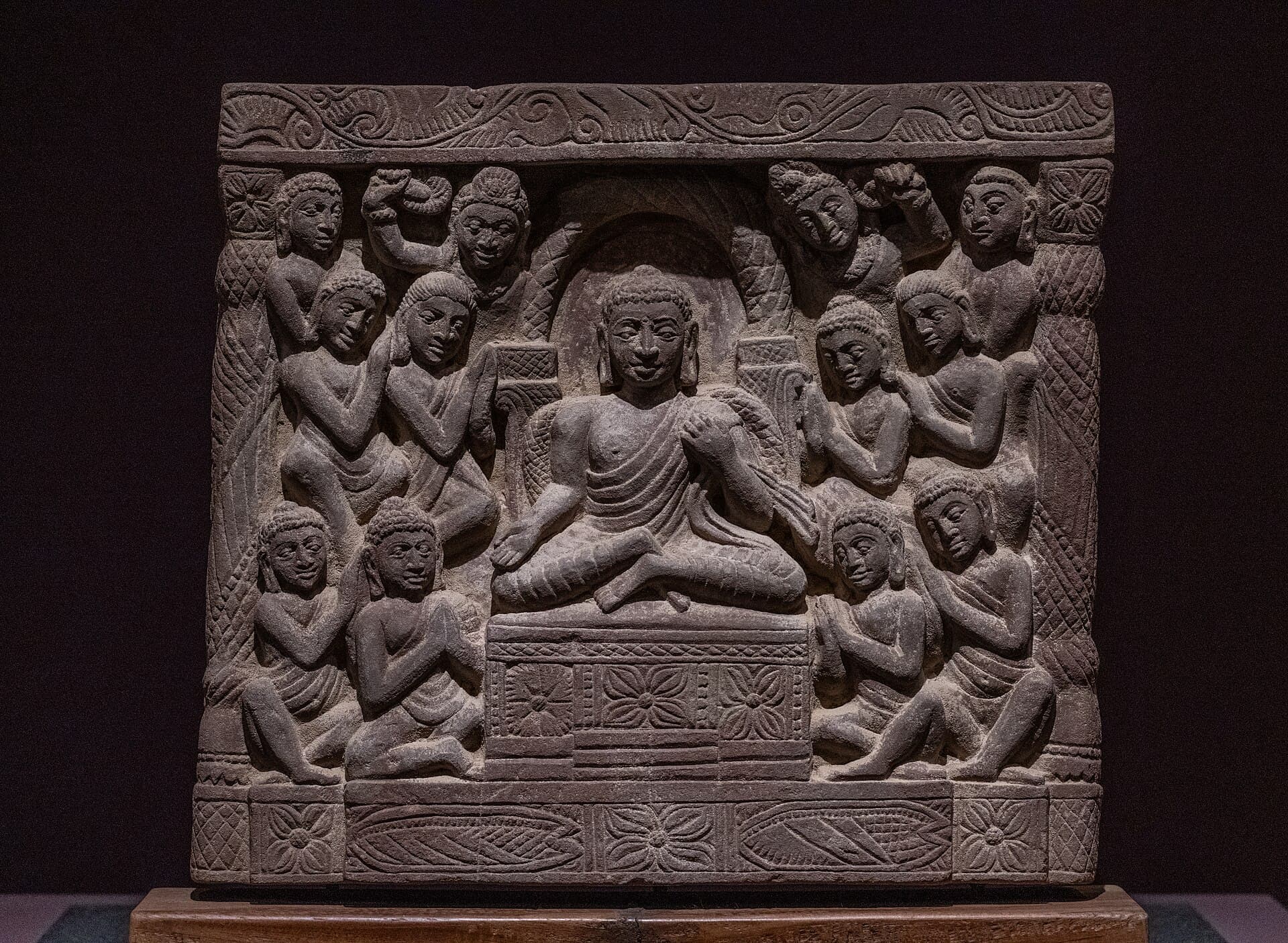
The Buddha's response, taught explicitly in the Anatta-lakkhana Sutta (SN 22.59), was the second formal teaching he gave at Sarnath, immediately after the Four Noble Truths. He addressed the five ascetics with a question rather than a claim. "Is form permanent or impermanent?" "Impermanent, venerable sir." "And what is impermanent — is that suffering or happiness?" "Suffering, venerable sir." "And what is suffering and subject to change — is it fitting to regard it as 'this is mine, this I am, this is my self?'" "No, venerable sir." The Buddha proceeded through the remaining four aggregates — feeling, perception, mental formations, consciousness — and arrived at the same conclusion in each case. It is said that the five attained arahantship as they heard this teaching land.
The doctrine is not nihilism. The Buddha did not say "there is no self" — he said that whatever can be observed is not-self. The distinction is everything. In the Vacchagotta Sutta (SN 44.10), the wanderer Vacchagotta asks directly: "Is there a self?" The Buddha is silent. "Then is there no self?" The Buddha is silent. Vacchagotta departs. Ananda asks why. The Buddha explains: had he said "there is a self," he would have sided with the eternalists, who held the Vedic doctrine of an unchanging ātman. Had he said "there is no self," he would have sided with the annihilationists, who held that the person is wholly destroyed at death. Both views, the Buddha says, would have only deepened Vacchagotta's confusion. The teaching of anatta cuts between.
What the Buddha is negating, precisely, is the false assumption that anywhere within the five aggregates there is a permanent, independent, controlling entity that constitutes "me." Look for it, the suttas keep insisting. Look in the body — it is changing every moment. Look in feeling — feelings rise and fall in seconds. Look in perception — perceptions shift with every glance. Look in the volitional formations — habits arise and pass. Look in consciousness — bare awareness is a stream of momentary cognitions, not a continuous witness. Where, in any of this, is the unchanging self?
The Visuddhimagga, Buddhaghosa's fifth-century synthesis of the Theravada, offers the analogy of the chariot: take it apart, and there is no chariot anywhere — only wheels, axle, pole, frame. The chariot is a name applied to the assembled parts; it is conventionally real but not inherently real. So with the person.
This analysis does not deny the conventional self. The canon is full of ordinary discourse about persons, choices, responsibility, and the continuation of the moral stream across rebirths. What it denies is the metaphysical self — the soul, the ātman, the changeless substrate. The conventional person is real as a process; the metaphysical self is not real at all.
The Mahayana extends anatta in the doctrine of "twofold selflessness": the selflessness of persons (pudgala-nairātmya) and the selflessness of phenomena (dharma-nairātmya). The Theravada had taught the first; the Mahayana adds the second. Not only is the person empty of inherent existence; so is every phenomenon, every element of experience, every dharma. This is the move from anatta to śūnyatā.
What anatta opens is liberation. The Anatta-lakkhana Sutta closes with the consequence: "Seeing thus, monks, the well-instructed disciple becomes disenchanted with form, disenchanted with feeling, perception, formations, consciousness. Being disenchanted, he becomes dispassionate. Through dispassion he is liberated. When liberated, there is the knowledge: 'liberated.'" The clinging to self is what makes suffering stick. When the clinging dissolves — and the doctrine of anatta is the dissolving — the suffering has nothing to stick to.
The teaching is not asking the practitioner to deny their existence. It is asking them to look, and to find honestly what is there. What is there is a stream — beautiful, suffering, conditioned, empty — and not a thing.