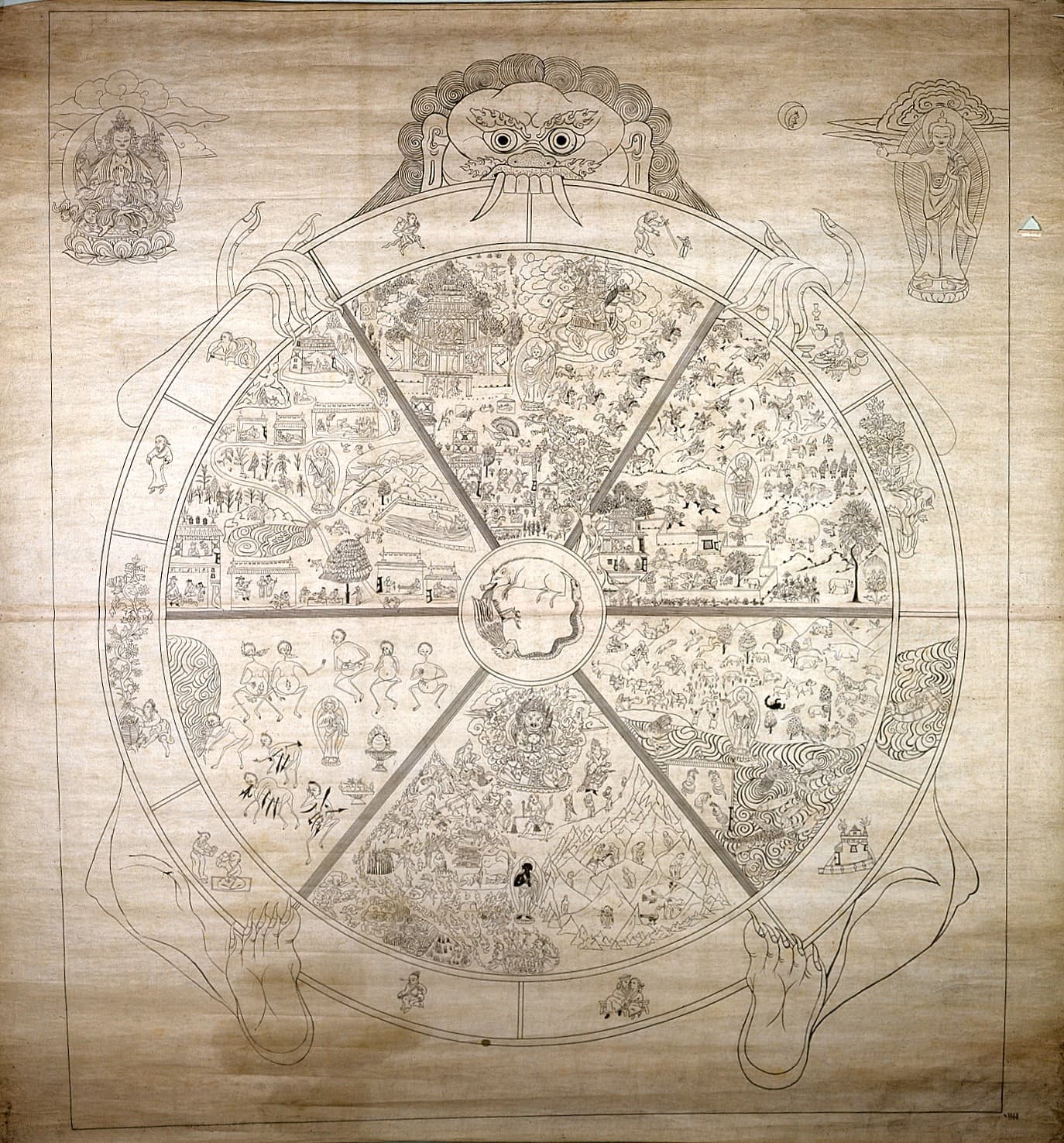
Saṃsāra is, etymologically, a wandering. The Sanskrit verbal root sṛ means "to flow," and the prefix saṃ intensifies it: a flowing-together, a continuous course, a wandering on. In the Buddhist usage, samsara is the beginningless round of birth, aging, sickness, death, and rebirth in which sentient beings have been circulating, driven by ignorance and craving, since time without beginning.
The Buddha's presentation of samsara is among his most vivid. In the Anamatagga-saṃyutta — the "without-discoverable-beginning" chapter of the Samyutta Nikaya (SN 15) — he offers a sequence of cosmic similes that have echoed through Buddhist literature for two and a half millennia. The tears beings have wept across the wandering of samsara, he tells the monks, are more than the water in the four great oceans. The bones a single being has accumulated across countless lives, if heaped together, would form a pile as great as Mount Vepulla. The mothers, the fathers, the brothers, the sisters, the children one has had in the long wandering — there is no being one has not been related to in some past life.
The point of these similes is not to inspire despair but urgency. Samsara is presented in the early canon not as a metaphysical commitment to be argued for but as a fact of experience the unawakened mind is in the process of generating moment by moment. The Buddha's emphasis is on the way out.
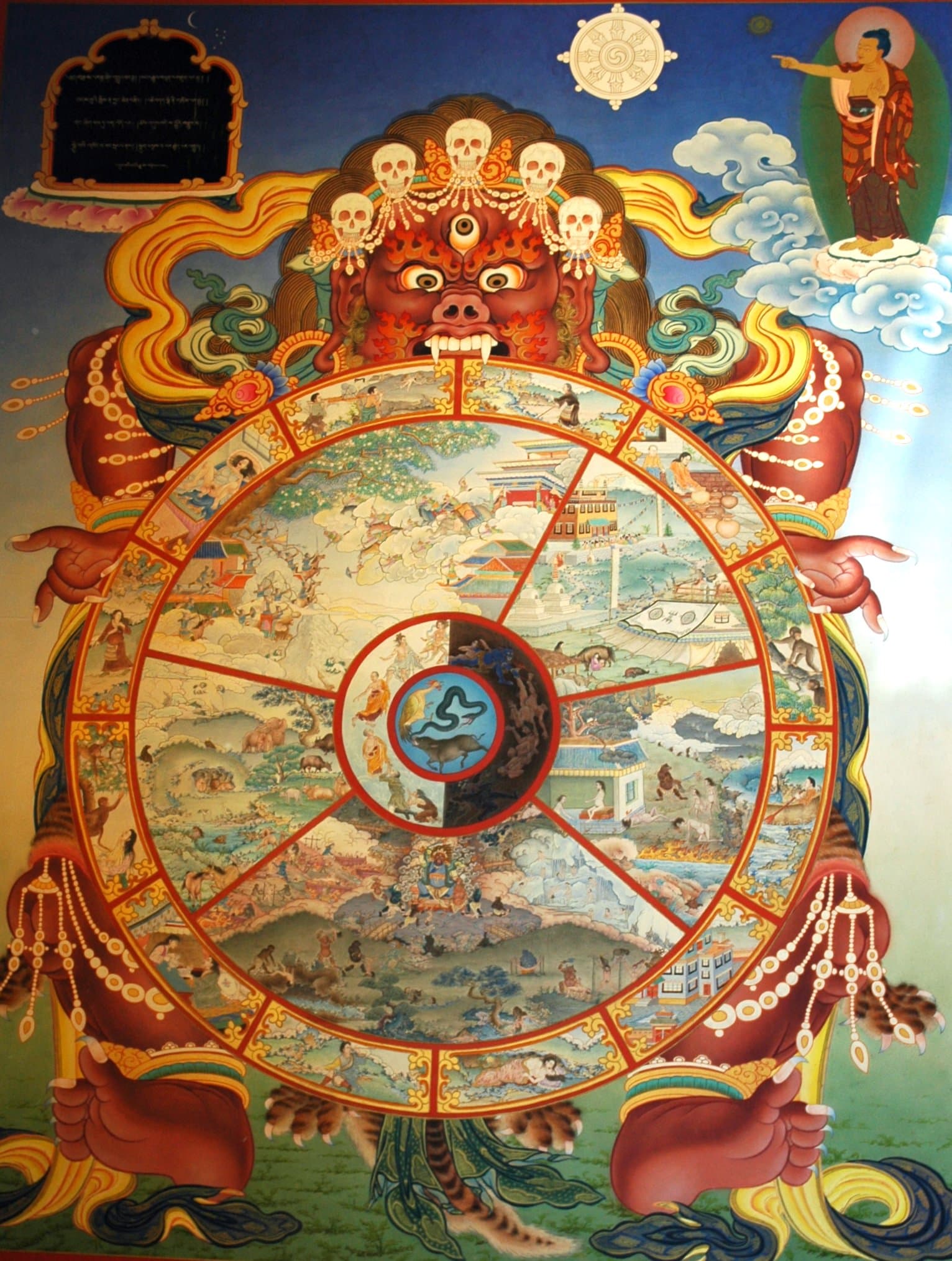
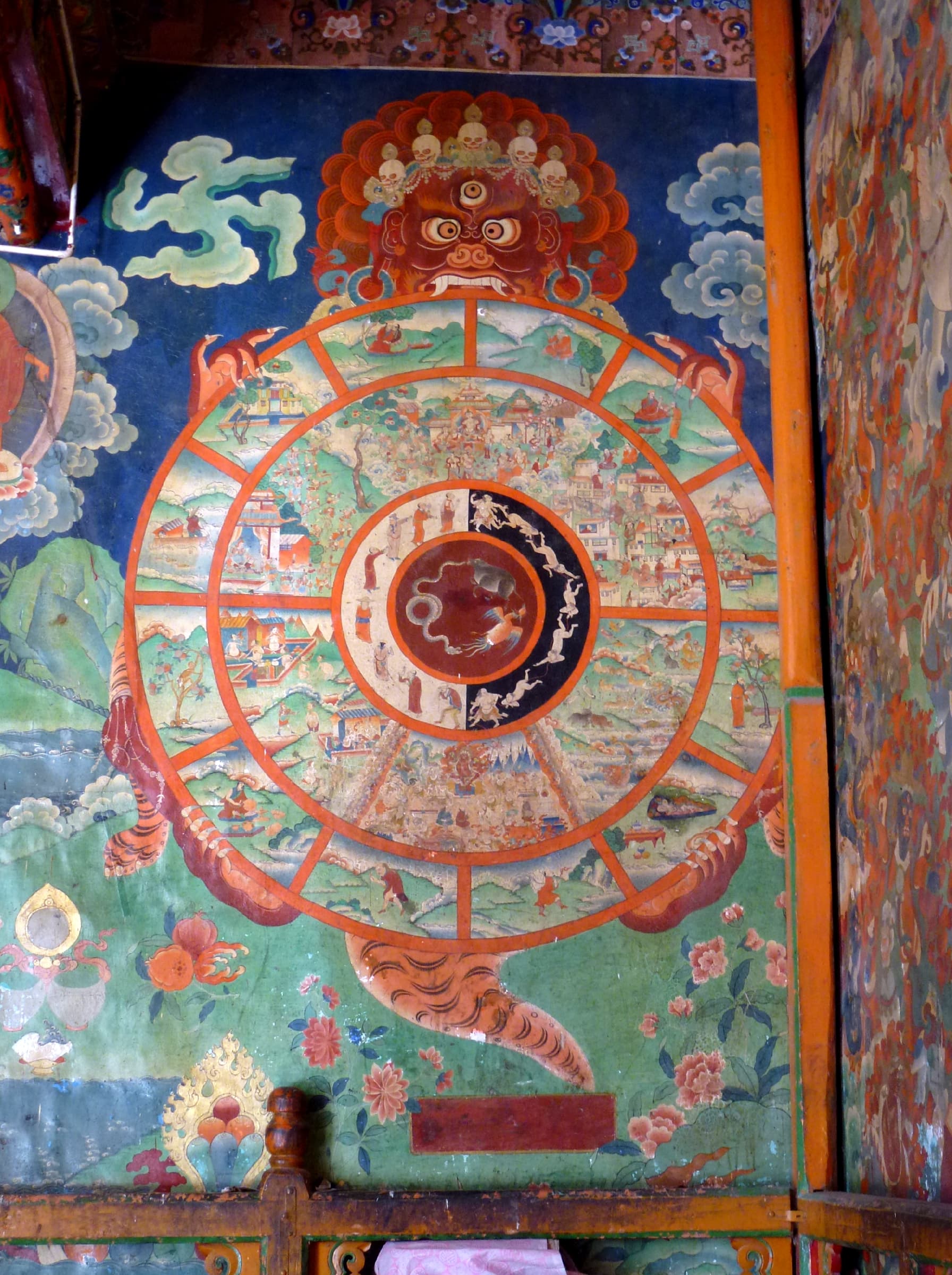
The architecture of samsara, in the classical exposition, has three nested elements. First, the twelve links of dependent origination, which describe the mechanism by which suffering perpetuates itself: ignorance gives rise to formations, formations to consciousness, and so on through the chain to birth, aging, and death. Second, the six realms of rebirth into which beings are born according to their karma: the realms of the gods (devas), the demigods (asuras), humans, animals, hungry ghosts (pretas), and hell-beings. Third, the three poisons — greed, hatred, and delusion — which are the immediate drivers of the cycle. These three appear at the hub of the bhavacakra, the Wheel of Becoming traditionally painted at the entrance to Tibetan monasteries: a cock, a snake, and a pig, each biting the tail of the next.
The six realms are read both literally and psychologically in the tradition. Read literally, they are six distinct rebirth destinations, each conditioned by a particular kind of karma — the god realm by pride and accumulated merit, the human realm by a balance of qualities, the animal realm by delusion, the hungry ghost realm by ungenerous greed, the hell realms by hatred, the asura realm by jealousy. Read psychologically, they are six states of mind that any human being passes through in the course of a single day. Both readings are textually defended, and the Tibetan tradition, especially Chögyam Trungpa's presentation in The Myth of Freedom, holds that both readings are necessary.
What makes samsara samsaric is not the existence of suffering as such but the structure of being driven. The unawakened mind, propelled by craving for pleasant experience and aversion to unpleasant experience, generates rebirth after rebirth without being able to step out of the pattern. Each new birth is conditioned by the karma of the last; each new birth generates further karma; the wheel turns. The Pali Canon's formula vaṭṭa — the round — captures the structure precisely.
The Mahayana extends the analysis. Nāgārjuna, in chapter 25 of the Mūlamadhyamakakārikā, makes the striking claim that samsara and nirvana are not, ultimately, two: "the limit of nirvana is the limit of samsara; between the two there is not even the slightest difference." What he means is not that the experience of bondage and the experience of freedom are the same — they are obviously and importantly different — but that they are not two separate realities. Samsara is samsara only because it is misperceived; seen rightly, the same field is nirvana. The bodhisattva therefore does not flee samsara but transforms the way it is held, returning lifetime after lifetime out of compassion until all beings are liberated.
In the Vajrayana, the recognition of samsara as the always-already-empty play of awareness becomes the operational basis of practice. The realms are not ultimately real, but the suffering of beings within them is not therefore unreal. The compassionate response is the bodhisattva's response.
What the dharma asks of the practitioner is not the rejection of samsara but the recognition of its actual structure — and the willingness to step out of the wheel, which is to say, to stop turning it from the inside. The Dhammapada (verse 153) records the Buddha's declaration on the night of awakening: "Through many a birth in samsara have I wandered in vain, seeking the builder of this house. Painful is repeated birth. Now you are seen, O builder of the house. You will not build again. Your rafters are broken, your ridgepole shattered. The mind, having attained the unconditioned, has reached the destruction of cravings."