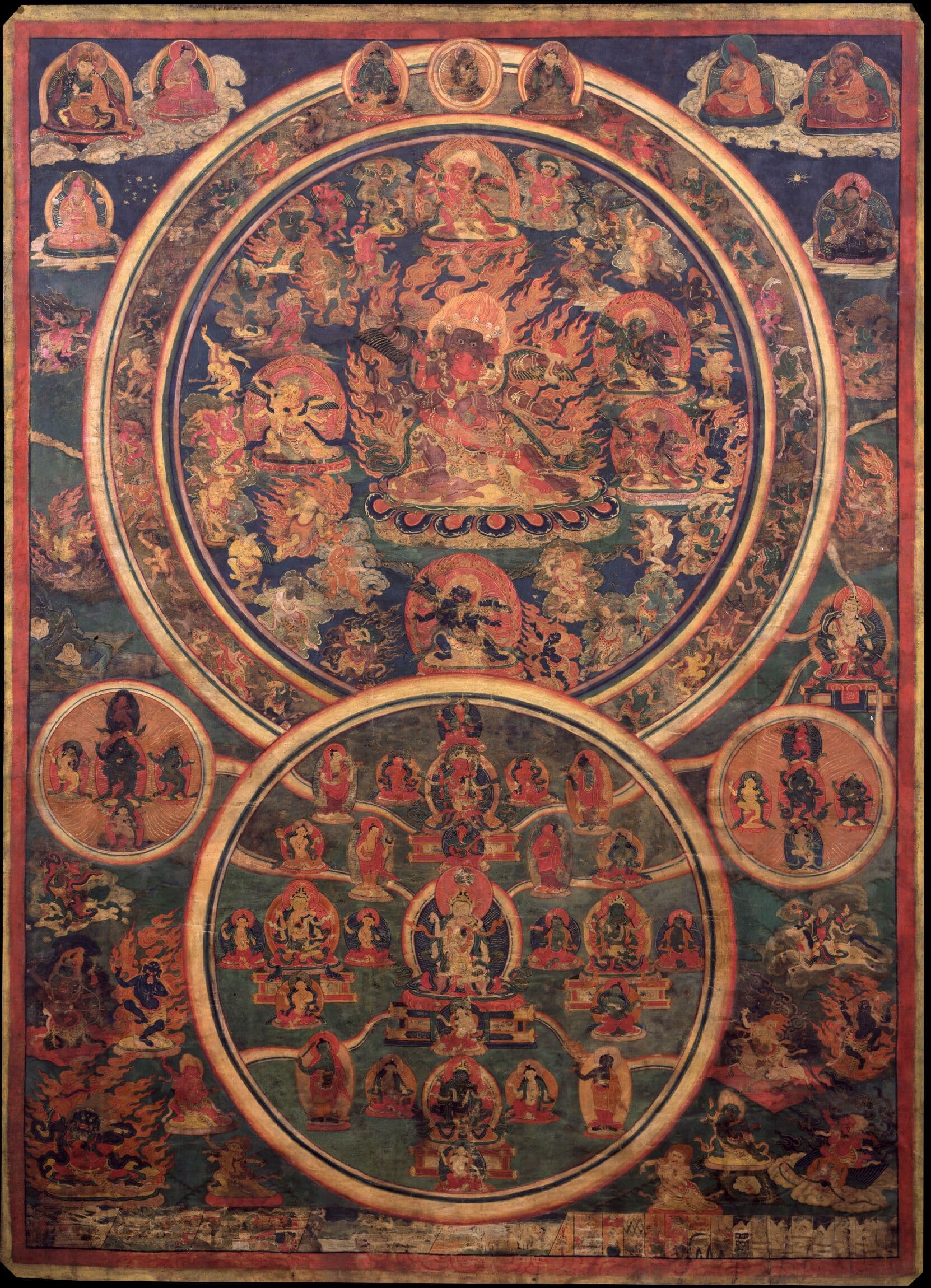
Bar do is a Tibetan compound meaning, almost literally, "in-between." Bar is "between"; do is a particle indicating the place or state. In its narrowest sense, bardo refers to the intermediate state between death and the next rebirth — the forty-nine days, by traditional count, during which the consciousness of the deceased traverses a series of luminous and terrifying appearances before being drawn toward a new birth. In its widest sense, bardo refers to any transitional state, any in-between, any liminal space where one structure has dissolved and the next has not yet stabilised. The Tibetan tradition identifies six bardos in total, covering the entire span of conscious experience.
The classical exposition is the Bardo Thödol — literally "Liberation Through Hearing in the Intermediate State" — composed in its current form in the fourteenth century by Karma Lingpa, drawing on terma (revealed treasure) traditions traced back to Padmasambhava in the eighth century. The text was popularised in the West under the misleading title The Tibetan Book of the Dead by W.Y. Evans-Wentz's 1927 translation. Later translations — Francesca Fremantle and Chögyam Trungpa (1975), Robert Thurman (1994), and Gyurme Dorje for the Penguin Classics edition (2005) — have done much to restore the text to its actual purpose, which is not a guidebook for the dead but a practice manual for the living.
The six bardos in the Nyingma classification are: the bardo of this life (kye ne bardo), the bardo of dream (milam bardo), the bardo of meditation (samten bardo), the bardo of dying (chikha bardo), the bardo of dharmatā or the luminous (chönyi bardo), and the bardo of becoming (sidpa bardo). Death occupies three of these — dying, luminosity, and becoming — and the Bardo Thödol's detailed teachings are addressed to all three.
The bardo of dying is the dissolution of the physical and mental constituents in the hours and days around death. The Tibetan tradition describes this dissolution in precise stages: earth dissolving into water (loss of physical strength), water into fire (loss of bodily warmth), fire into air (loss of metabolic heat), air into consciousness (cessation of breath), and then the dissolution of consciousness itself into the clear light of dharmatā. For an awakened practitioner, this final clear light is the recognition of the natural state — the very buddha-nature uncovered. For most beings, it passes unrecognised and the next phase begins.
The bardo of dharmatā is the most extraordinary phase. The text describes the deceased consciousness encountering a series of brilliant lights and peaceful deities, followed by wrathful deities, all of which are projections of the deceased's own mind. The recognition that these appearances are not external but are the natural display of one's own awareness is the moment of potential liberation. The Bardo Thödol is read aloud to the dying and the recently deceased precisely as a guide to this recognition — hence the title "Liberation Through Hearing."
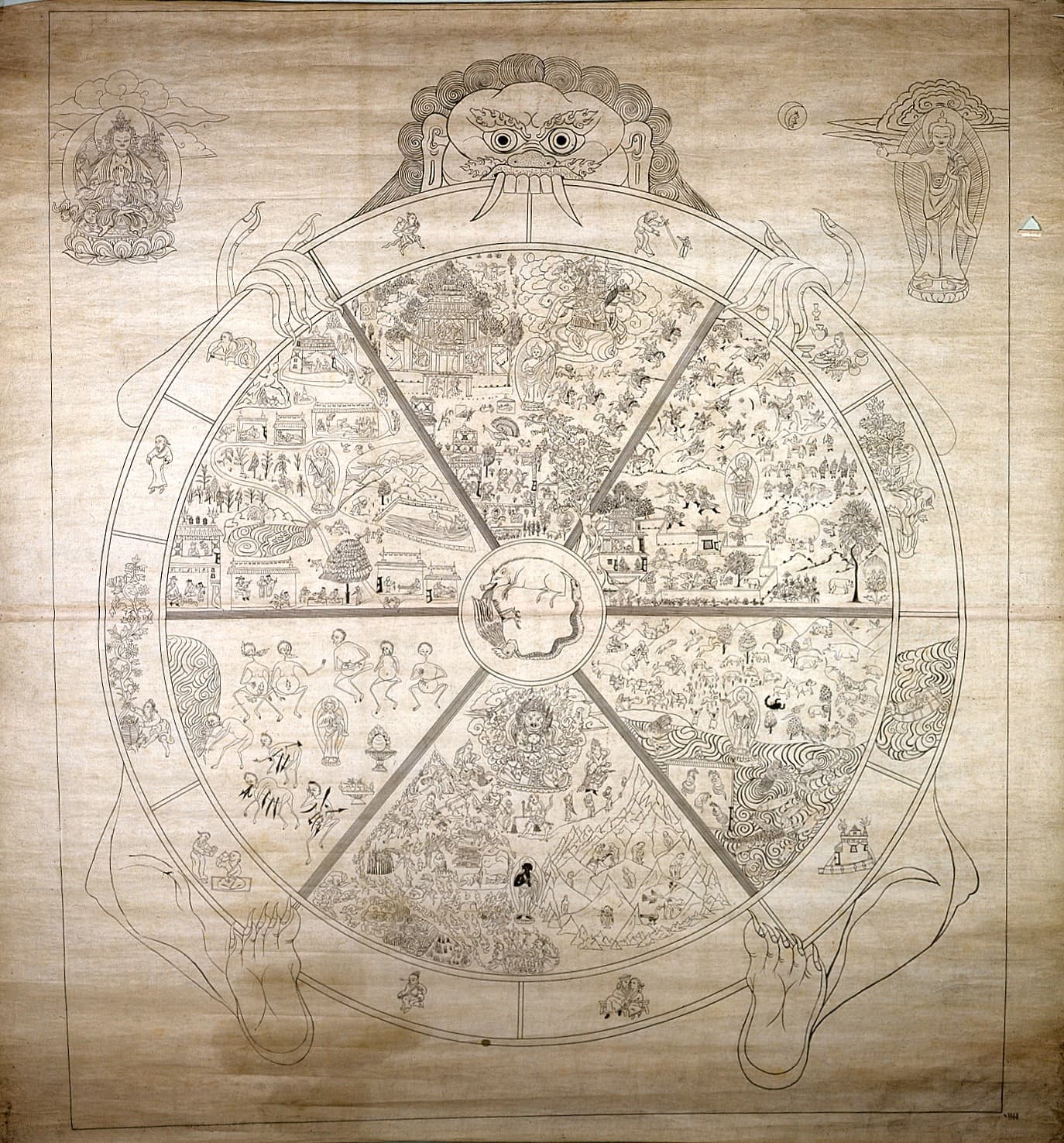
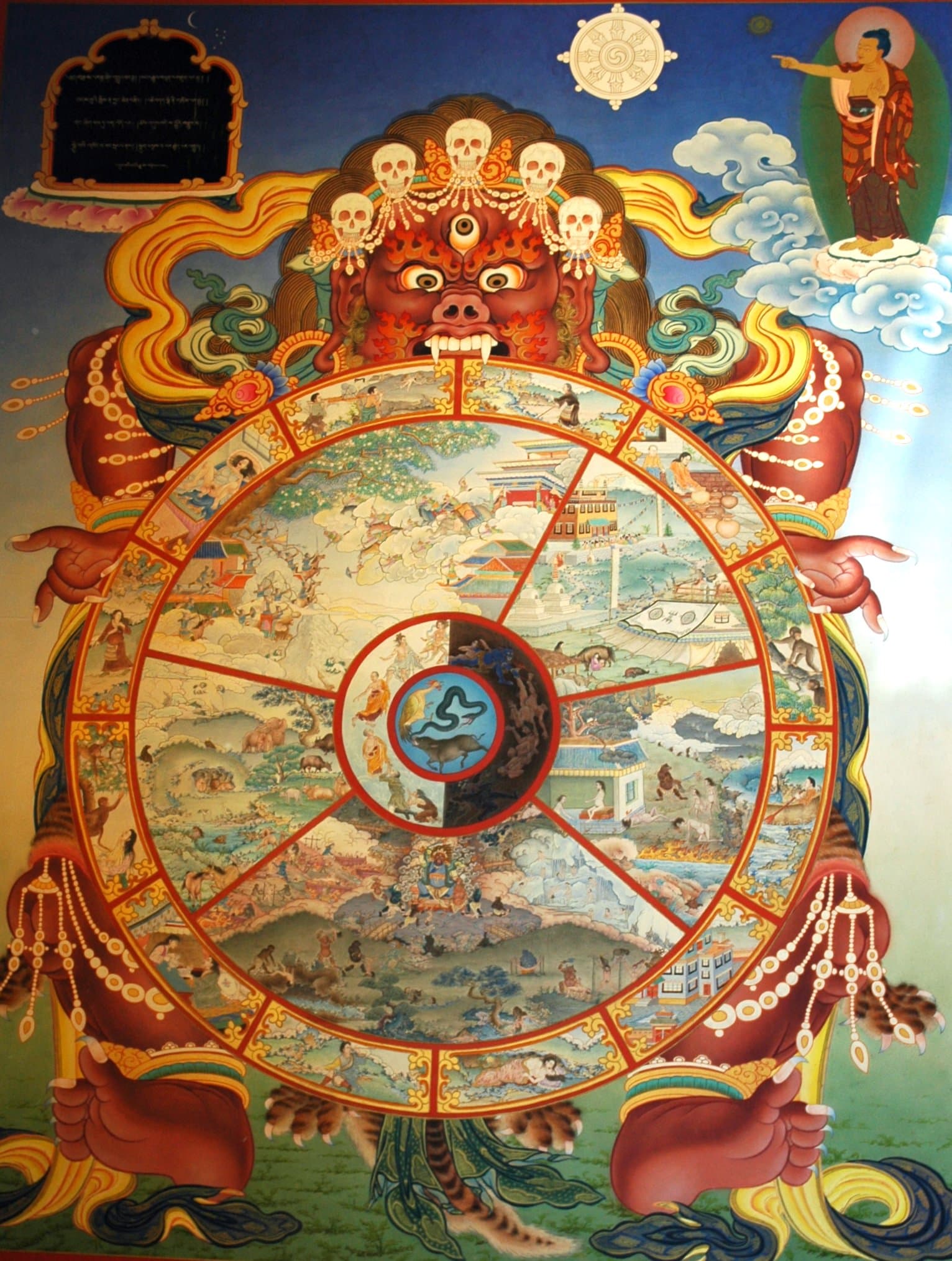
The bardo of becoming is the search for the next rebirth. Driven by the karmic momentum of the previous life, the consciousness is drawn toward a new conception, and the wheel turns again.
The bardo teachings are not, in the Tibetan understanding, primarily about death. They are about the recognition of the natural state in any in-between. The bardo of dream is the same recognition applied to the transition between waking and sleeping; the bardo of meditation is the same recognition cultivated deliberately in practice. The point is that the in-between spaces — the moments when ordinary structures have loosened and the next have not yet hardened — are uniquely workable. They are the places where the natural state can be glimpsed.
This is why Chögyam Trungpa, in his commentary in the Fremantle translation, insisted that the bardo teachings are for the living. The bardo of this life is itself a bardo — a passing-through. Every moment of transition, every loss, every disorientation, every gap in the habitual flow of self-construction is a small bardo. The practitioner who learns to recognise these gaps in life will recognise the larger gap at death. The practice and the dying are not two separate skills.
Sogyal Rinpoche's The Tibetan Book of Living and Dying, published in 1992, became the standard contemporary presentation of the bardo teachings for Western readers, and reframed them for a culture that had largely lost its instructions for death. The teachings have entered Western palliative care, hospice work, and the broader contemplative response to mortality.
What the bardo teaches is that no transition is empty. Every in-between is a workable space — and the workable space, finally, is awareness itself, recognising its own nature.