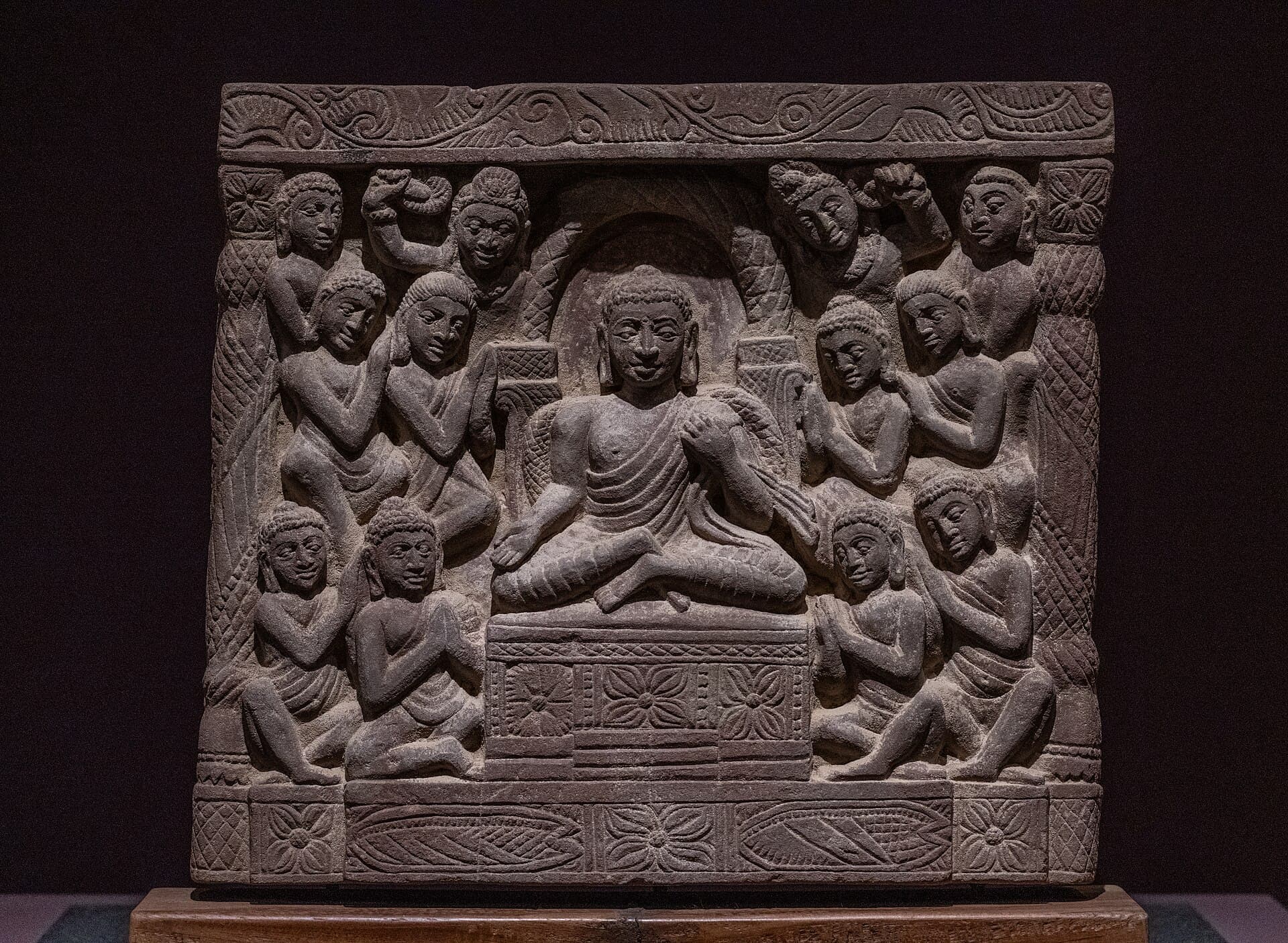
In the second sermon delivered at Sarnath — the Anattalakkhana Sutta (SN 22.59) — the Buddha returned to the same five ascetics who had heard the Dhammacakkappavattana five days earlier and offered them an analytical demonstration of non-self. He took each of the five components of personal experience in turn and asked, of each, whether it could be controlled, whether it was permanent, whether it was satisfactory. The five all failed each test. Therefore, he concluded, none of them was self; nor were they together a self; nor was self somewhere in or behind them. At the end of the sutta the five became arahants — the first arahants after the Buddha himself.
The five aggregates (Sanskrit skandha, Pali khandha) are:
Form (rupa). The body and all material phenomena. The four great elements — earth, water, fire, wind — and their derivatives. The body that walks, eats, sleeps, ages, sickens, and dies. The whole of the physical sphere of experience.
Feeling (vedana). The hedonic tone of every experience — pleasant, unpleasant, or neither. Not emotion in the modern sense; feeling in this technical sense is the bare affective register of contact. Every moment of consciousness has a feeling-tone, and the feeling-tone is the hinge on which craving turns. Pleasant feeling, ungrasped, does not produce attachment. The aim of the second satipatthana is precisely to know feeling as feeling, without the further reaction.
Perception (sanna). The recognizing function — the marking of what something is. Blue is recognized as blue, table as table, anger as anger. Perception is what allows experience to be referred to memory and language; it is also where most distortion enters. The Buddhist analysis of perception is extremely fine: every act of perception carries the seed of grasping or aversion in the form of mental marking.
Mental formations (sankhara). The most heterogeneous category — fifty-one specific mental factors in the Abhidhamma, including volition, attention, contact, mindfulness, concentration, wisdom, faith, greed, hatred, delusion, and the rest. This is where karma is made: the formations are the volitional weight that one moment of mind delivers to the next.
Consciousness (vinnana). The bare knowing of an object — six varieties, corresponding to the six sense bases (eye, ear, nose, tongue, body, and mind). Consciousness in the canonical analysis is always consciousness of something; it does not exist apart from its object.
The five together account for the whole of any moment of subjective experience. There is no sixth category — no soul, no permanent witness, no irreducible self standing behind them. This is the heart of the anatta teaching. When the Buddha was asked whether the self exists, or does not exist, he refused both alternatives: the question presupposes the wrong analytical category. Run the analysis through the five aggregates and there is no place left where a self could be.
The practical importance of the analysis is enormous. It is the framework of the second and third satipatthana — the foundations of mindfulness on feeling and on mind. It is the analytical basis of the Mahasi noting technique — every note is the recognition of an aggregate. It is the conceptual ground of the Theravada vipassana sequence of insights into impermanence, dukkha, and anatta. Bhikkhu Bodhi has written that one cannot really understand the Buddha's teaching without working through the aggregate analysis personally, on the cushion, in one's own experience.
The Mahayana inherited the analysis from the Theravada essentially intact. The Heart Sutra's opening — "the bodhisattva Avalokitesvara, practicing the perfection of wisdom, perceived that the five aggregates are all empty" — assumes the analysis but adds that even the aggregates themselves are empty of own-being. This does not negate them; it locates them in their dependent arising. Form is empty; emptiness is form.