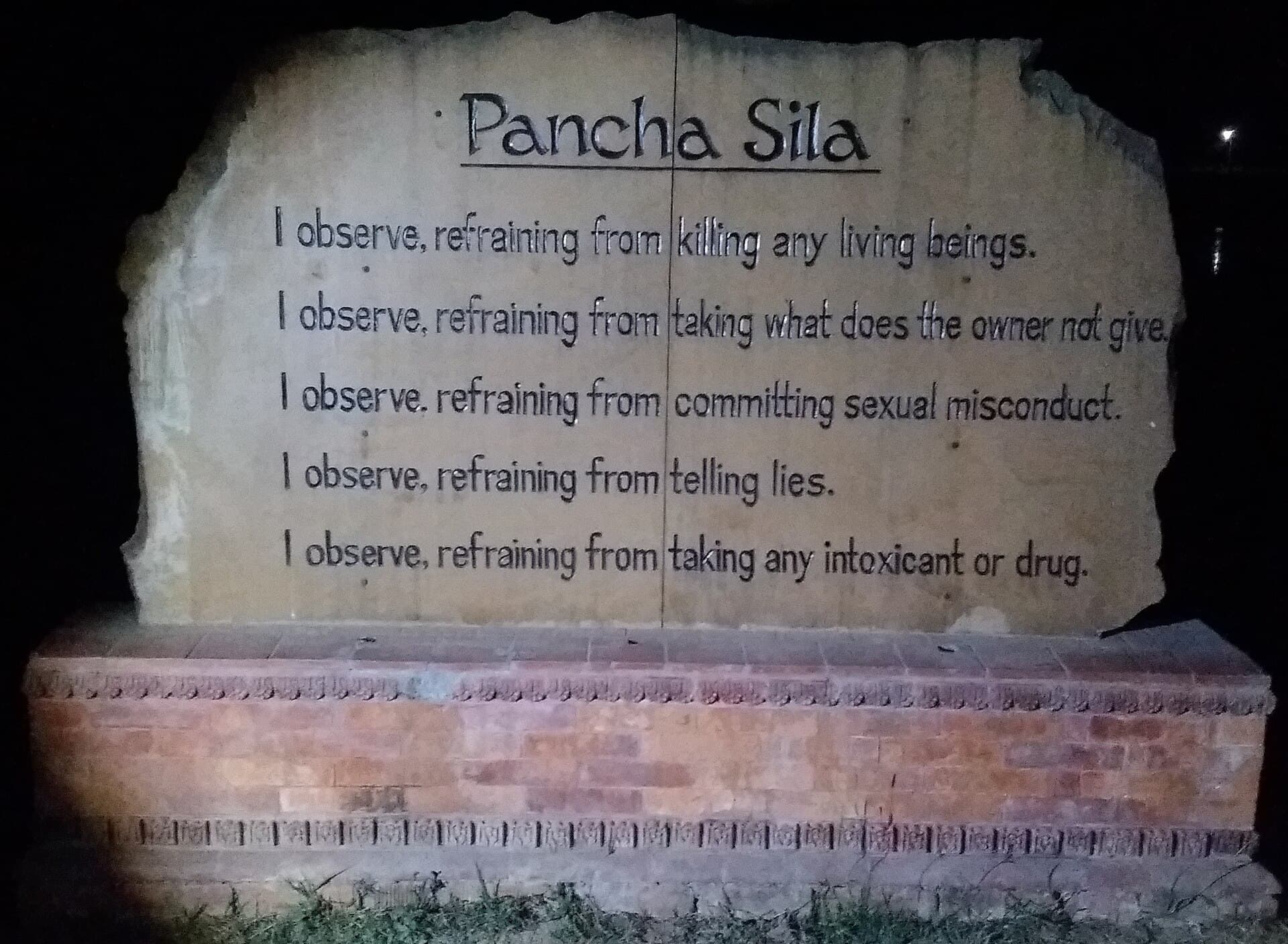
In the Pali tradition, the five precepts (pañca-sīla) are recited immediately after the three refuges. To become a Buddhist is, in the same breath, to undertake five trainings: I undertake the training to abstain from taking life (pāṇātipātā veramaṇī), from taking what is not given (adinnādānā veramaṇī), from sexual misconduct (kāmesu micchācārā veramaṇī), from false speech (musāvādā veramaṇī), and from intoxicants that cloud the mind (surāmeraya-majja-pamādaṭṭhānā veramaṇī).
The grammar matters. The Pali word sikkhāpada means "training-rule," not "commandment." The formula is not "thou shalt not" but "I undertake the training to abstain." The precepts are voluntary undertakings, taken up by the practitioner as a gift to themselves and to all beings. The framing is therapeutic rather than juridical. The Anguttara Nikaya (AN 8.39) calls the precepts "great gifts" — abhayadāna, the gift of fearlessness — because one who keeps them gives to all beings freedom from fear of harm.
Each precept has a positive correlate. The Theravada commentaries, and more recently the framing of Thich Nhat Hanh's "Five Mindfulness Trainings," make this explicit. Abstaining from killing is the cultivation of compassion and the protection of life. Abstaining from taking what is not given is the cultivation of generosity (dāna) and respect for what belongs to others. Abstaining from sexual misconduct is the protection of trust and the cultivation of fidelity. Abstaining from false speech is the cultivation of truthfulness and the speech that creates harmony rather than division. Abstaining from intoxicants is the protection of mindfulness — for everything in the path depends on the unclouded mind, and the fifth precept is what keeps the conditions for practice intact.
The precepts are not absolute prohibitions in the manner of monotheistic commandments. They are graduated. The Vinaya for monastics elaborates them into 227 rules for bhikkhus and over 300 for bhikkhunīs, and adds three more for novices and lay practitioners observing the eight precepts on uposatha days. The lay practitioner can extend the five to eight on full-moon and new-moon observance days, adding abstention from eating after noon, from entertainments and adornments, and from high or luxurious beds. The ten precepts are the standard for novices.
The depth of each precept reveals itself in practice. The first — to abstain from taking life — extends in the Mahayana traditions, especially East Asian and Tibetan, to a strong default toward vegetarianism, though the Theravada has historically permitted meat-eating provided the animal was not killed specifically for the monastic. The Brahmajāla Sutta (DN 1) and the Sigālovāda Sutta (DN 31) elaborate the wider ethical field: not only the gross act but the planning, the encouragement, the rejoicing in another's act of killing all weigh on the karma.
False speech, the fourth, is treated by the Buddha as the most fundamental. In the Cūḷa-Rāhulovāda Sutta (MN 61), he tells his son Rahula, then a young novice, that one who feels no shame in telling a deliberate lie is "empty" — has emptied themselves of the conditions for the path. The Buddha then says that mindfulness must be brought to every action of body, speech, and mind: before acting, while acting, after acting. This is the form ethical training takes from the inside.
The fifth precept, often softened in modern Western contexts, is presented in the canon with unusual sharpness. Intoxicants are pamādaṭṭhāna — the very basis of heedlessness. The Sigālovāda Sutta lists six dangers of drink: present waste of money, increase of quarrels, susceptibility to disease, disreputable name, indecent exposure, and the weakening of intelligence. For a tradition whose entire path rests on sati — mindfulness — anything that systematically dulls the clarity of awareness is a structural problem.
The precepts are the ground. As Bhikkhu Bodhi writes in Going for Refuge and Taking the Precepts, "sīla is not a higher achievement; it is the floor of the path." Without it, samādhi will not stabilise, and without samādhi, paññā will not arise. The five precepts are, in this exact sense, the minimum architecture of awakening.