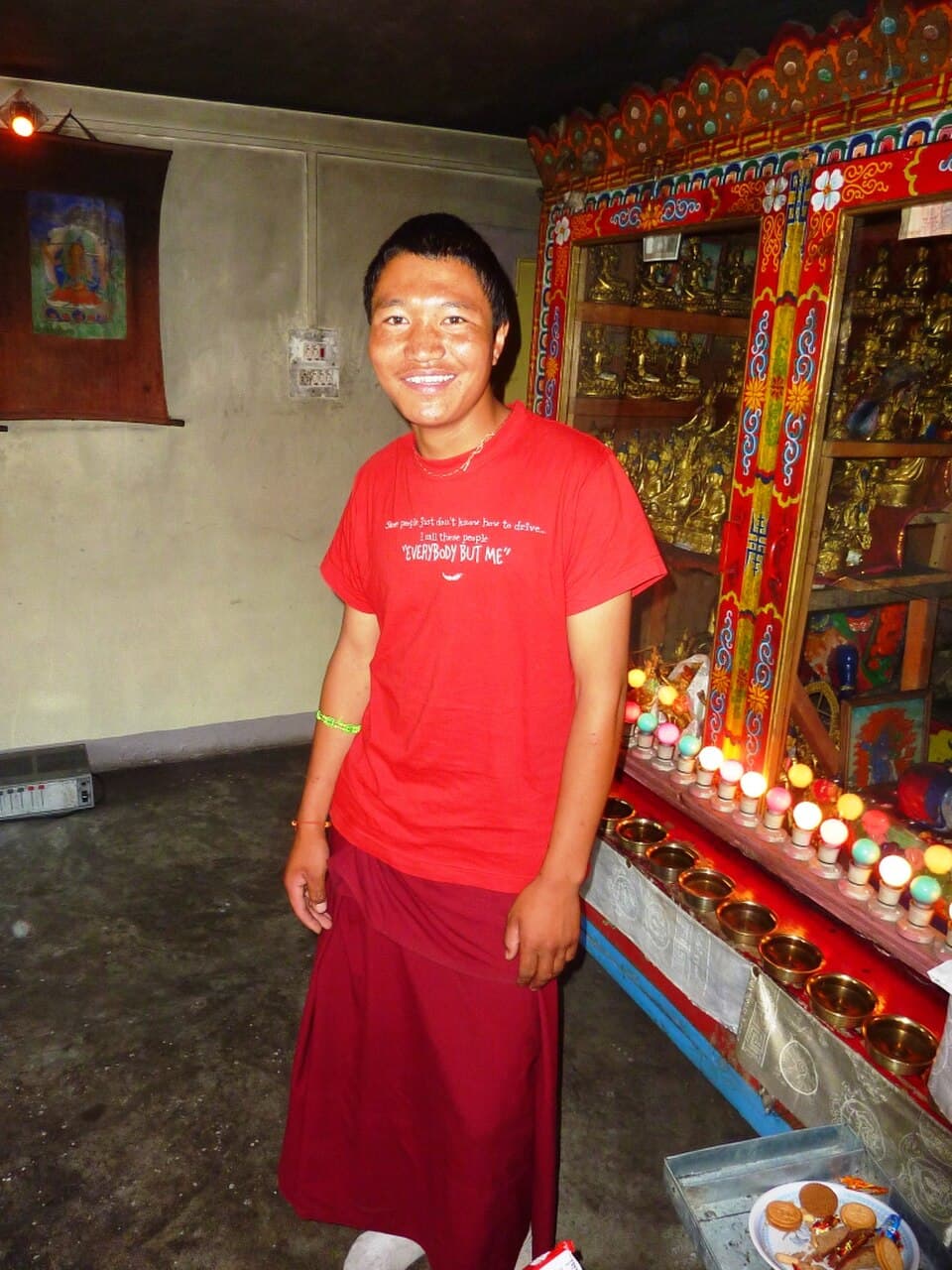
Ven. Ashok Vajracharya is a senior Vajracharya — the hereditary priestly tradition of Newar Buddhism — and one of the principal living teachers of the indigenous Buddhist tradition of the Kathmandu Valley.
The Vajracharya tradition is unique in the Buddhist world: it is a non-celibate Vajrayana priesthood transmitted hereditarily within Newar families, descended unbroken from the late Indian Buddhist mahasiddha lineages. After the fall of Buddhist India in the thirteenth century, the Vajracharyas of the Kathmandu Valley became the last continuous Vajrayana lineage of the Indian subcontinent — preserving Sanskrit Buddhist canonical literature, the Pancha Buddha sadhana cycle, the rituals of the Vasundhara and Vajrasattva mandalas, and the iconography of late Pala-era Buddhist tantra.
Ven. Ashok was initiated into the Vajracharya tradition at fourteen, undertaking the bare chuyegu — the initiation ceremony unique to Vajracharya boys — at Itum Bahal, the medieval baha (Buddhist courtyard monastery) at the centre of Kathmandu. He has since served as a senior priest at Itum Bahal and has taught generations of younger Vajracharyas in the textual and ritual heritage.
He is particularly noted for his scholarly work on the Pancha Buddha cycle — the five-Buddha mandala which is the heart of Newar Vajrayana — and on the role of the Vasundhara goddess in Newar devotional life. He has been instrumental in the documentation of the Newar Buddhist heritage with academic researchers from the Asian Art Museum, the Rubin Museum, and the University of Hamburg.
Applications for personal time are received through Itum Bahal on a monthly cadence, with particular openness to international students seeking initiation into the Newar Buddhist tradition. The Vajracharya tradition is unusual in welcoming serious foreign practitioners, though the textual and ritual training is substantial.


