
Mahayana
The Great Vehicle
The Mahayana — the Great Vehicle, the Bodhisattvayana — emerges in Indian Buddhism somewhere between the first century BCE and the first century CE, and it makes a claim no earlier school had made: that the proper aspiration of a Buddhist is not to become an arahant who exits samsara, but to become a fully awakened buddha (samyaksambuddha) who returns again and again to liberate all sentient beings, however long that takes, however many kalpas it requires. The vehicle is great because it carries everyone.
Three shifts define the Mahayana. The first is the bodhisattva ideal. The Bodhicaryavatara of Santideva (eighth century, Nalanda) puts it with unmatched precision: 'For as long as space endures, for as long as sentient beings remain, may I too remain, to dispel the misery of the world.' The second is the doctrine of sunyata — emptiness — articulated by Nagarjuna in his Mulamadhyamakakarika (c. 150 CE). All phenomena, including the dharmas analyzed by Abhidhamma, are empty of inherent existence; they exist only in dependence. The third is the development of an immense new corpus of sutras claimed as the word of the Buddha, including the Prajnaparamita (Perfection of Wisdom) literature, the Lotus Sutra, the Avatamsaka Sutra, the Vimalakirti Sutra, the Lankavatara Sutra, and the Pure Land sutras.
The philosophical schools that crystallize within the Mahayana are themselves remarkable institutions. Madhyamaka, founded by Nagarjuna and developed by Aryadeva, Buddhapalita, Bhavaviveka, Candrakirti, and Santaraksita, holds that the middle way between eternalism and nihilism is found in the emptiness of all conceptual fabrication. Yogacara, founded by the brothers Asanga and Vasubandhu in the fourth–fifth centuries, holds that what we take to be external reality is a transformation of consciousness (vijnaptimatrata, 'consciousness-only'). The Tathagatagarbha tradition, drawn from sutras like the Srimaladevi and Mahaparinirvana, teaches that all beings already possess the buddha-nature; awakening is recognition, not acquisition. These three streams — emptiness, mind-only, buddha-nature — become the philosophical bedrock for every subsequent Mahayana school across Asia.
“The Bodhicaryavatara of Santideva (eighth century, Nalanda) puts it with unmatched precision: 'For as long as space endures, for as long as sentient beings remain, may I too remain, to dispel the misery of the world.”
The Mahayana also revolutionized Buddhist devotion. Where the Pali suttas remember a single human Buddha and an unspecified number of past buddhas, the Mahayana opens up a cosmos of buddhas: Amitabha in the Pure Land of the West, Aksobhya in the East, Bhaisajyaguru the Medicine Buddha, Vairocana the cosmic Buddha of the Avatamsaka, and the trans-human bodhisattvas — Avalokitesvara (Chenrezig, Guanyin, Kannon), Manjusri the wielder of the sword of wisdom, Vajrapani, Ksitigarbha, Maitreya the future Buddha. The Three Bodies doctrine (trikaya) — dharmakaya, sambhogakaya, nirmanakaya — formalized in Yogacara, gives this cosmology its architecture.

The great Mahayana institutions were the Indian monastic universities: Nalanda (founded fifth century, destroyed 1193), Vikramasila, Odantapuri, Somapura, and Jagaddala. From there the Mahayana traveled outward — to China across the Silk Road starting in the first century CE, where Kumarajiva (344–413) and later Xuanzang (602–664) translated the major sutras into Chinese; to Korea, Japan, Vietnam, the Newar valley in Nepal, and to Tibet, where the entire Indian Mahayana corpus was rendered into Tibetan and preserved after Indian Buddhism's collapse.
Mahayana is now the largest Buddhist body in the world, with roughly 360–500 million adherents across East Asia. It is not one school but a family: Chan / Zen / Seon / Thien (the meditation school), Pure Land (Jingtu / Jodo), Tiantai / Tendai (Lotus-centered), Huayan / Kegon (Avatamsaka-centered), Yogacara / Faxiang, Sanlun (Madhyamaka), Nichiren, the Tibetan Mahayana that became Vajrayana, and Newar Buddhism — all are Mahayana. What unites them is the bodhisattva vow, the doctrine of emptiness, and the conviction that the buddha-mind is not far away but the very nature of mind itself.
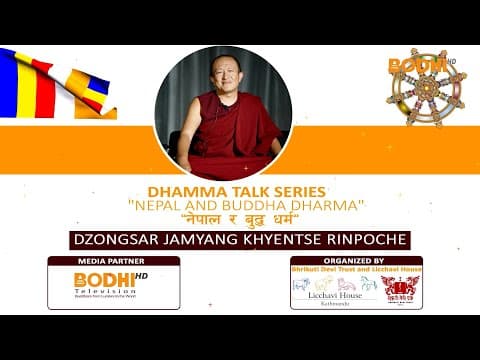
Nepal and the Buddha Dharma — Part I
Dzongsar Jamyang Khyentse Rinpoche in Kathmandu
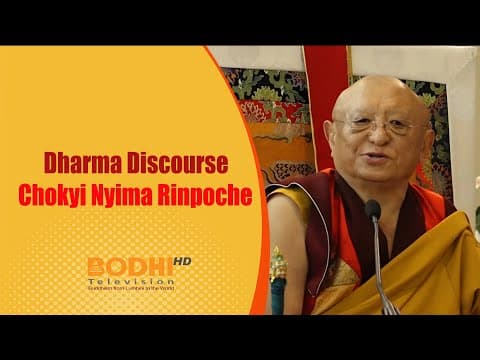
Dharma Discourse — Session I
Kyabje Chokyi Nyima Rinpoche at Ka-Nying
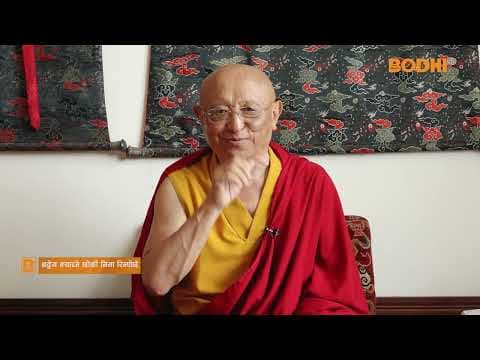
Without Knowing Emptiness, There Is No Freedom from Suffering
Kyabje Chokyi Nyima Rinpoche
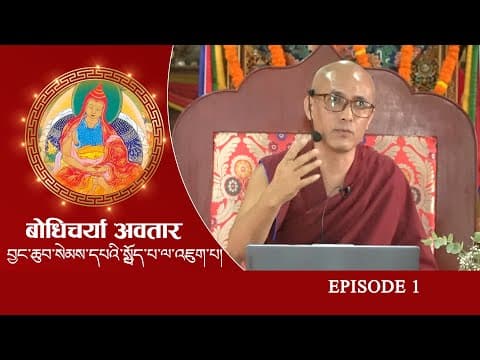
The Bodhicaryavatara — Episode 01
Shantideva's Way of the Bodhisattva