
Ananda
Treasurer of the dhamma
For twenty-five years, the Buddha walked the dusty roads of the Ganges plain with his cousin Ananda at his side — and yet, when the Buddha died at Kushinagar between the two sal trees, Ananda was still a sotapanna, a stream-enterer, one stage short of arahantship. He attained the highest awakening only the night before the First Council convened, the council he had been forbidden from attending unless he was an arahant. The story tells you everything about him.
He was born on the same day as Siddhartha, the Sanskrit and Pali traditions both record — a Shakya cousin, son of Suddhodana's brother Amitodana. He was ordained in the second year of the dispensation, along with a cluster of Shakya cousins — Anuruddha, Bhaddiya, Bhagu, Kimbila, and Devadatta — when the Buddha first returned to Kapilavastu. Of that group, all but Devadatta became arahants; only Ananda took longer than the rest. He attained stream-entry on the day of his ordination, and stayed there.
For the first twenty years of the dhamma, the Buddha had no permanent attendant. Various bhikkhus served him in rotation — some carelessly, the texts say. In the twenty-first year, the Buddha announced to the assembly that he wanted a permanent attendant. The senior bhikkhus all volunteered; the Buddha accepted none. Ananda alone said nothing. When asked, he replied that he would accept the post if the Buddha would agree to eight conditions — four refusals and four requests. He would refuse all special food, special robes, special lodging, and the inheritance of any of the Buddha's own gifts. He would request the right to bring questioners to the Buddha at any hour, the right to ask the Buddha for clarification of any teaching he had missed, the right to repeat to the Buddha anything that had been taught in his absence, and the right to know the Buddha's thoughts on his behalf. The Buddha accepted all eight. The arrangement defined the canon. Almost every sutta in the four nikayas opens with the formula "evaṃ me sutaṃ" — "thus have I heard" — and the one who heard, almost always, was Ananda.
“He attained the highest awakening only the night before the First Council convened, the council he had been forbidden from attending unless he was an arahant.”
He is the most quoted figure in the canon outside the Buddha himself. The Mahaparinibbana Sutta (DN 16) — the long account of the Buddha's last months — is essentially Ananda's memoir. He carries the Buddha's bowl. He arranges the room for the dying body between the two sal trees. He asks the Buddha what to do with the relics. He weeps, alone, against a doorpost, until the Buddha calls him in and says, "Enough, Ananda, do not weep. Have I not told you, again and again, that all things dear and pleasant are unstable, that we must part from them?" He receives the Buddha's instruction that, after the parinirvana, the dhamma and the Vinaya will be the teacher in the Buddha's place. He hears the last words: "appamādena sampādetha" — "strive on with diligence." He arranges the funeral.
His great work, however, came after. Mahakassapa convened the First Council at the Sattapanni cave at Rajagaha within months of the parinirvana. The five hundred bhikkhus selected to recite the canon had to be arahants. Ananda was not. He sat outside the cave on the night before the council and meditated through the night, the canonical account says, on the body — pacing, then sitting, then about to lie down. As his head was descending toward the pillow but had not yet touched it, his foot still off the ground, he attained arahantship. He entered the cave through the keyhole the next morning by psychic power, and recited every word he had heard, beginning with the first sutta and ending with the last.

He also opened the door to women's ordination. When the Buddha first refused Mahaprajapati Gotami's request, Ananda asked the Buddha three times whether women, properly trained, could attain stream-entry, once-returning, non-returning, and arahantship. Each time the Buddha said yes. Ananda then said: "Then, Lord, since the path is open to them, let Mahaprajapati be ordained." The Buddha agreed. The bhikkhuni order exists because Ananda asked.
He died, the commentaries record, at the age of one hundred and twenty, the same age as Mahakassapa. He had asked permission to enter parinibbana at the midpoint of the Ganges between the two kingdoms of Magadha and Vesali, so that neither could claim his relics over the other. He rose in the air above the river, divided his body into two equal halves by the fire-element, and the relics fell to both banks. The dhamma he had carried in his memory had been transcribed by then. He is, in the Mahayana tradition, the second patriarch — the one to whom Mahakassapa transmitted the lineage, and from whom every later school descends.
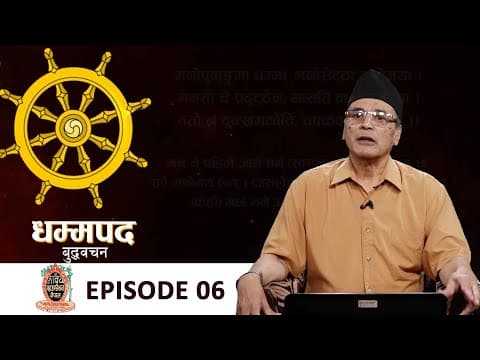
The Dhammapada in Daily Life — Episode 06
Verse and commentary
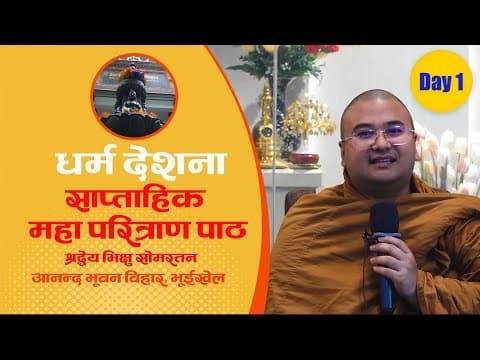
The Weekly Maha Paritrana — Day 1
Anand Bhuvan Vihar · Ven. Somaratan
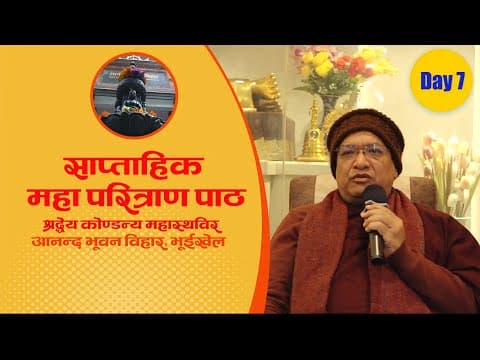
The Weekly Maha Paritrana — Day 7
Anand Bhuvan Vihar, Bhuikhel · Ven. Kondanya Mahathero
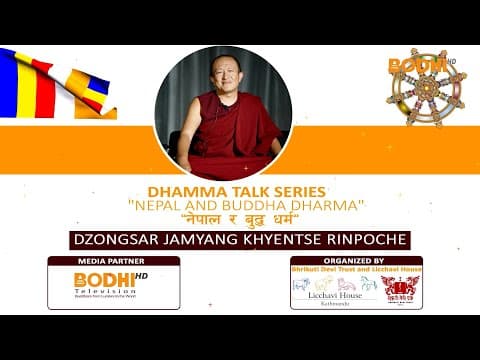
Nepal and the Buddha Dharma — Part I
Dzongsar Jamyang Khyentse Rinpoche in Kathmandu