
Mahaprajapati Gotami
First bhikkhuni, mother of the order
Her name in the Pali sources is Mahāpajāpatī Gotamī. She was the younger sister of Mayadevi, daughter of Añjana of the Koliya line, married — along with her sister — to Suddhodana of the Shakyas. When Mayadevi died seven days after the birth of Siddhartha, Mahaprajapati took the infant as her own. The commentaries record that she had given birth to her own son, Nanda, a week earlier, and that she handed Nanda to a wet-nurse so that she could nurse the future Buddha herself. The Anguttara commentary on her foremost designation says simply: "she was his mother in every way except the womb."
She was the queen of Kapilavastu for the next thirty-five years. She raised both Siddhartha and her own son Nanda, and the Buddha's half-sister Sundari. When Siddhartha left for his renunciation, she was in her early fifties; when he returned five years later as the Buddha, she was the first householder in Kapilavastu to attain stream-entry on hearing him preach. When her husband Suddhodana fell ill some years later, the Buddha attended his deathbed; under the Buddha's instruction, Suddhodana himself became an arahant before he died. Mahaprajapati was now a Shakya widow in her late sixties or seventies. Her son Nanda had been ordained. Her stepson was the Buddha. Her grandson Rahula had been ordained. The household was empty.
She walked to the Buddha, then teaching at the Nigrodha Grove outside Kapilavastu, and asked: "Lord, would it be possible for women to go forth from the household life into homelessness in the dhamma and discipline that you have proclaimed?" He refused. She asked a second time. He refused. She asked a third time. He refused. She left.
“She was the younger sister of Mayadevi, daughter of Añjana of the Koliya line, married — along with her sister — to Suddhodana of the Shakyas.”
The Cullavagga (X) records what happened next as the first organized political act in the history of the Buddhist Sangha. Mahaprajapati cut off her hair, put on the yellow robe of a renunciant, and walked from Kapilavastu to Vaishali — a distance of more than two hundred kilometers — followed by five hundred Shakya women who had done the same, the wives and mothers of the Shakya men who had already been ordained. Their feet bled. They arrived at the Kutagara hall in the Great Wood where the Buddha was staying. Mahaprajapati stood outside the gate, dust-covered, weeping. Ananda saw her, learned what she wanted, and went to the Buddha.
Ananda asked: "Lord, are women, going forth in this dhamma and discipline, capable of attaining the fruits of stream-entry, once-returning, non-returning, and arahantship?" The Buddha replied: "They are capable, Ananda." Ananda said: "If so, Lord, and since Mahaprajapati was your nurse, your foster mother, the one who gave you milk after your own mother died — it would be good if women were permitted to go forth." The Buddha then gave the eight garudhammas — the eight heavy rules by which bhikkhunis would be subordinated to the bhikkhu sangha in matters of discipline — and said: "If Mahaprajapati accepts these eight, that will be her ordination." Ananda took the eight rules to her. She accepted them with the famous phrase: "As a young woman fond of ornaments accepts a garland of lotuses placed upon her head, so do I accept these eight rules, not to be transgressed throughout my life."
The bhikkhuni order had been founded. The Buddha is recorded — and the passage is the subject of two and a half millennia of commentarial argument — as saying afterward that the lifespan of the dhamma had been shortened from a thousand years to five hundred by the admission of women. Scholars have long suggested the line was a later interpolation; the bhikkhuni Thullananda, the elder Khema, and Bhadda Kapilani would soon disprove the misogyny of the framing by their attainments. Mahaprajapati herself became an arahant within weeks of her ordination. The Anguttara (AN 1.235) places her as foremost among the bhikkhunis in long-standing seniority — the bhikkhuni of the longest standing.
She lived to a great age. The Therigatha preserves her verses (Thig 157-162): "Homage to you, Buddha, hero among men. From the suffering, I and many others have been released. Suffering is fully understood. Craving has dried up. The path has been developed; cessation has been touched. I have been a mother, a son, a father, a brother, a grandmother in past lives. Not knowing the truth, I wandered. Now, having seen the Blessed One, this is my last body. The round of birth and death has been worn through." She entered parinibbana before the Buddha, in the company of her five hundred bhikkhunis, on a single day, after asking the Buddha's permission and giving her final salutations. She is the matriarch of the women's lineage. Every bhikkhuni since has come through her.
When Buddhist Education Recedes, Society Suffers
Revered Dr. Dhammavati Guruma
A Discourse at Dharmakirti Vihar
Revered Dr. Dhammavati Guruma
Mina Guruma — Episode 01
A discourse series with Revered Mina Guruma
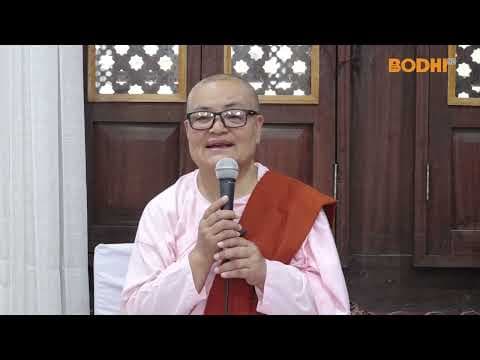
Mina Guruma — Episode 02
A discourse series with Revered Mina Guruma