
Rahula
The Buddha's son, foremost in the desire for training
He was born at Kapilavastu on the night his father walked away from the palace. The Pali sources record that Siddhartha, upon hearing of the birth, said only "rāhulajāto bandhanaṃ jātaṃ" — "a Rahula is born, a fetter is born" — and the name stuck. Rāhu in the older astronomy is the eclipse-demon who swallows the sun; rāhula is its diminutive: little eclipse, little fetter. The boy grew up at the Shakya court without a father, raised by his mother Yashodhara, his grandfather Suddhodana, and his great-aunt Mahaprajapati Gotami.
The Buddha returned to Kapilavastu in the second year of his teaching. Yashodhara, the Dhammapada commentary records, dressed the seven-year-old Rahula in his best clothes, pointed to the begging Buddha in the courtyard below, and said: "That is your father. Go and ask him for your inheritance." The boy walked down, fell into step beside the Buddha as he left the palace, and said, "Father, give me my inheritance." The Buddha did not break stride. At the Banyan Grove on the edge of the city, he turned to Sariputta and said: "Ordain him."
The robe was placed on him by Sariputta as preceptor and Mahamoggallana as teacher. He was, by tradition, the first samanera — the first child novice — in the Sangha. When Suddhodana heard, he came to the Buddha in grief. He had lost his son to renunciation, his nephew Nanda to ordination, and now his grandson. He asked the Buddha to make a rule: that no child be ordained without parental consent. The Buddha agreed, and the rule stands in the Vinaya to this day.
“The Pali sources record that Siddhartha, upon hearing of the birth, said only "rāhulajāto bandhanaṃ jātaṃ" — "a Rahula is born, a fetter is born" — and the name stuck.”
The canonical record then follows Rahula through three discourses the Buddha addressed to him personally. The Ambalatthika-Rahulovada Sutta (MN 61) is the famous instruction on truthfulness: the Buddha tips out the water in a basin, then turns the empty basin over, and says, "Just as little merit remains in the practice of one who knows he is speaking falsely. Whatever practice such a person has done is turned over like this basin." Lie about anything, the Buddha tells him, and the practice tips out. The boy is perhaps eight years old when he hears this. The Maha-Rahulovada Sutta (MN 62) is the instruction on meditation: contemplate the body as earth, water, fire, air, space, and consciousness — six elements without selfhood — and develop the in-and-out breathing practice. The Cula-Rahulovada Sutta (MN 147) — the third — is the final teaching: a discourse on the impermanence of the senses, given when Rahula was, the commentary says, about twenty and ready. At the end of it, the canonical phrase: "And while this teaching was being given, the mind of Venerable Rahula was released from the asavas without clinging." He became an arahant.
The Anguttara Nikaya 1.207 places him as foremost among the bhikkhus in the desire for training (sikkhā-kāmānaṃ aggo). The Apadana preserves his verses, in which he says: "I am the son of the Blessed One in two ways — the son of his body and the son of his dhamma." The Theragatha includes four verses (Thag 295-298) attributed to him: a quiet record of the contentment of the renunciant life he was given before he was old enough to choose it.
He predeceased his father. The Pali sources do not date his death precisely; the tradition holds that he died in his early forties, before the Buddha's own parinirvana, possibly in the heaven of the Thirty-Three after a brief illness. Mahamoggallana and Sariputta, the two who had taken him in as a child, also predeceased the Buddha. By the end, the Buddha had outlived his son, his two chief disciples, and most of the generation he had ordained at the start. The Mahaparinibbana Sutta does not mention Rahula by name. He had already gone.
Later traditions — particularly the Mulasarvastivada and the East Asian Mahayana — would give Rahula extensive elaboration. In Chinese Buddhism he is the patron of esoteric practice and the silent one among the sixteen arhats. The Tibetan tradition counts him among the Sixteen Elders (gnas brtan bcu drug), the arhats who agreed to remain in the world until the coming of Maitreya. He is the figure between father and dharma — born as a fetter, ordained as the inheritance, and held by both lineages as the unbroken thread.
The Dhammapada in Daily Life — Episode 02
Verse and commentary
Mina Guruma — Episode 02
A discourse series with Revered Mina Guruma
Dharma Discourse — Session I
Kyabje Chokyi Nyima Rinpoche at Ka-Nying
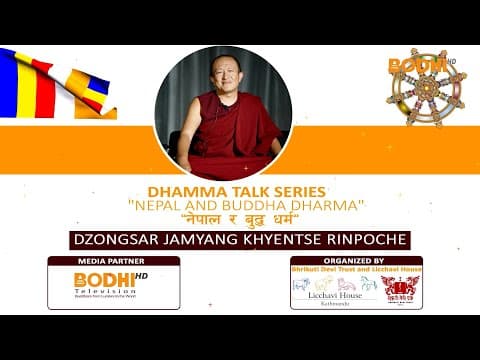
Nepal and the Buddha Dharma — Part I
Dzongsar Jamyang Khyentse Rinpoche in Kathmandu