The Tibetan Diaspora
1959 — the flight into exile, and the global spread of Vajrayana
On March 17, 1959, after nine days of armed uprising against Chinese rule in Lhasa, the senior leadership of the Gelug school slipped out of the Norbulingka Palace and crossed south into exile. Two weeks later, after crossing the Himalayas on horseback through Lhuntse Dzong and Tawang, the party reached the Indian border at Khenzimane on March 31. Approximately 80,000 Tibetans followed over the next two years, the largest of several waves; the total Tibetan diaspora today numbers about 150,000, concentrated in India (Dharamsala, Bylakuppe, Mundgod, Mainpat), Nepal (Boudhanath, Mustang, Solu-Khumbu), Bhutan, the United States, Canada, Switzerland, Australia, and Taiwan.
What happened next is one of the most remarkable cultural transplantations in modern history. The Tibetan government-in-exile, established at Dharamsala in Himachal Pradesh, became a functioning quasi-state with a parliament, a constitution, a school system, monasteries, and a population census. The four major Tibetan Buddhist schools each re-established themselves outside Tibet. The Gelug rebuilt Drepung and Sera and Ganden in southern India at Mundgod and Bylakuppe; the same monastic education curriculum that produced geshe lharampa degrees in Lhasa now produces them in Karnataka. The Nyingma re-established Mindrolling at Dehra Dun and Namdroling at Bylakuppe (the largest single Tibetan monastery outside Tibet, with several thousand monks). The Kagyu schools re-established Rumtek in Sikkim under the 16th Karmapa Rangjung Rigpe Dorje, who fled to Sikkim in 1959 and built Rumtek as the seat-in-exile of the Karma Kagyu. The Sakya re-established Sakya College in Dehra Dun and other institutions; the 41st Sakya Trizin, Ngawang Kunga, has been a leading figure in the global transmission. The Bon tradition re-established at Menri Monastery in Dolanji.
The Vajrayana then traveled outward. Three vectors are worth naming. The first is monastic exchange: Tibetan teachers began visiting and teaching in the West from the late 1960s onward. Chogyam Trungpa Rinpoche (1939–1987), a Kagyu / Nyingma master who escaped Tibet in 1959 and studied at Oxford, founded Naropa University in Boulder in 1974 and established the Shambhala lineage — one of the largest Western Vajrayana communities. Tarthang Tulku (b. 1934), a Nyingma master, founded the Tibetan Nyingma Meditation Center in Berkeley in 1969 and Dharma Publishing. Sogyal Rinpoche (1947–2019), despite the later abuse scandals that ended his teaching career, founded Rigpa with centers in over forty countries and authored The Tibetan Book of Living and Dying (1992), one of the most widely read Buddhist books of the late twentieth century. Lama Yeshe (1935–1984) and Lama Zopa Rinpoche founded the FPMT — Foundation for the Preservation of the Mahayana Tradition — which now operates over 160 centers in forty countries. Dilgo Khyentse Rinpoche, Penor Rinpoche, the late Chatral Rinpoche, and many others taught widely in the West. Dzongsar Khyentse Rinpoche, who maintains active teaching presences in Bhutan, Nepal, India, North America, Europe, and Asia, represents the second-generation diaspora teacher class.
“On March 17, 1959, after nine days of armed uprising against Chinese rule in Lhasa, the senior leadership of the Gelug school slipped out of the Norbulingka Palace and crossed south into exile.”
The second vector is public teaching on a global scale. From the 1970s onward, senior Tibetan lamas began giving public teachings and empowerments — including the Kalacakra, conferred to audiences numbering in the hundreds of thousands — that introduced Tibetan dharma far beyond the monastic world. Sustained dialogues between Tibetan Buddhist teachers and Western scientists, beginning with the Mind and Life Institute in 1987, created one of the most enduring Buddhist-scientific conversations in history, running for decades and continuing today.
The third vector is the publication and translation infrastructure. Padmakara Translation Group, Rangjung Yeshe Publications, Snow Lion (now Shambhala), Wisdom Publications, the Tibetan Buddhist Resource Center (now the Buddhist Digital Resource Center, BDRC) under Gene Smith, the 84000 project to translate the entire Kangyur into English, and Lotsawa House have made the vast Tibetan canon increasingly available in English, French, German, Spanish, Russian, and Chinese. What was a closed lineage requiring decades of study in Tibetan can now be approached, though not mastered, in translation.
The diaspora has costs and tensions. The Cultural Revolution destroyed an estimated 6,000 of Tibet's 6,250 monasteries; the population inside Tibet has lived under Chinese rule for sixty-five years; the question of Gelug succession politics remains unresolved and will define Tibetan Buddhism for the rest of the twenty-first century. But the dharma is now everywhere. The Vajrayana that crossed the Himalayas in the eighth century has crossed every other border since.
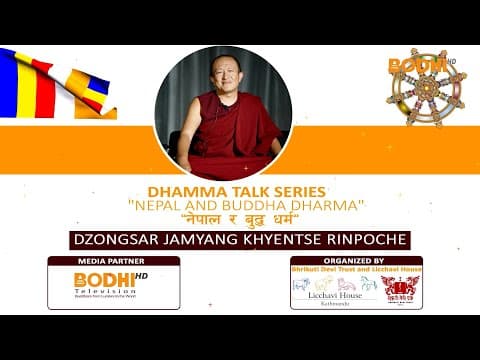
Nepal and the Buddha Dharma — Part I
Dzongsar Jamyang Khyentse Rinpoche in Kathmandu
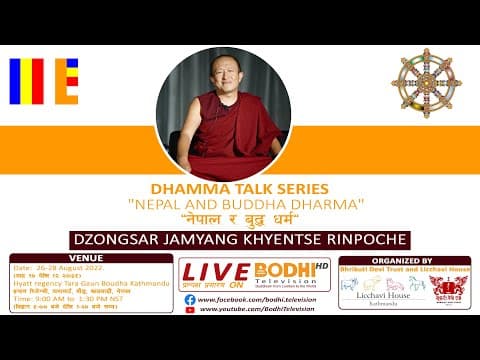
Nepal and the Buddha Dharma — Part II
Dzongsar Jamyang Khyentse Rinpoche in Kathmandu
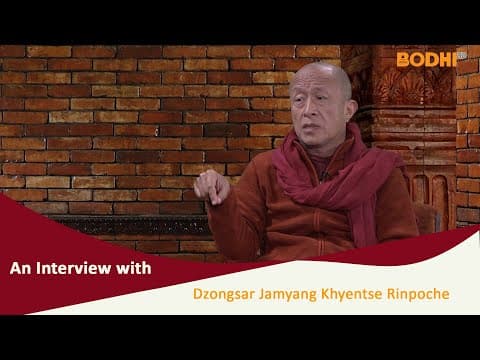
An Interview with Dzongsar Jamyang Khyentse Rinpoche
On practice, lineage, and the question of belief
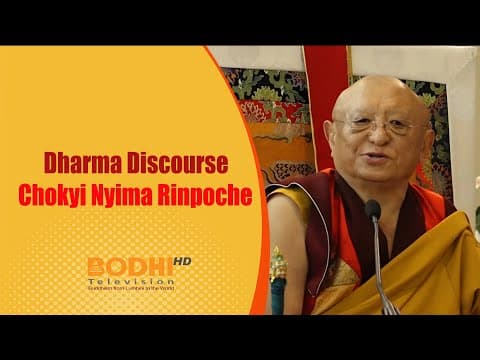
Dharma Discourse — Session I
Kyabje Chokyi Nyima Rinpoche at Ka-Nying

