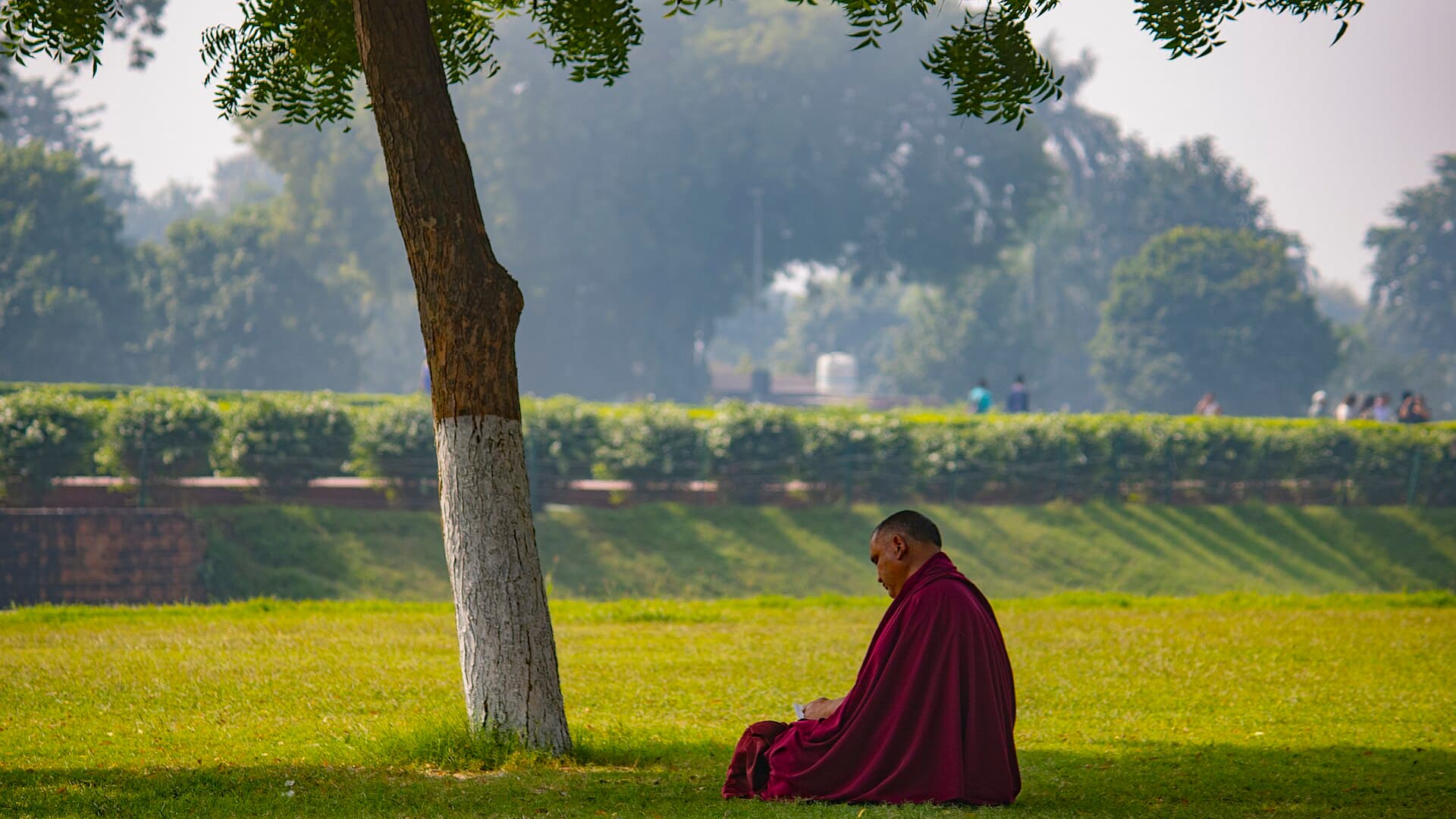
Pilgrimage — The Outer Practice
The four places a faithful pilgrim should visit
Three months before his death, the Buddha said something extraordinary to Ananda. 'There are these four places, Ananda, that a faithful clansman should visit with feelings of reverence. Which four? The place where the Tathagata was born. The place where the Tathagata realized the supreme perfect enlightenment. The place where the Tathagata set in motion the supreme Wheel of the Dhamma. The place where the Tathagata passed away into the Nibbana-element with no residue remaining. These, Ananda, are the four places a faithful clansman should visit with feelings of reverence. And, Ananda, faithful bhikkhus, bhikkhunis, laymen, and laywomen will come, contemplating: Here was the Tathagata born. Here did the Tathagata realize the supreme perfect enlightenment. Here was the supreme Wheel of the Dhamma set in motion by the Tathagata. Here did the Tathagata pass away into Nibbana. And those who, while making such a pilgrimage, should die with a believing heart, will at the break-up of the body after death be reborn in a realm of heavenly happiness.' (DN 16.5.8)
This passage, in the Mahaparinibbana Sutta, is the canonical foundation of Buddhist pilgrimage. The four places — Lumbini, Bodh Gaya, Sarnath, Kushinagar — are the same four sites a Buddhist pilgrim visits today. The Buddha named them explicitly. He did not name a fifth.
“Three months before his death, the Buddha said something extraordinary to Ananda.”
In the centuries after the Buddha's death, the practice expanded. Ashoka, in the 3rd century BCE, made the four-site pilgrimage and erected pillars at each place. The Chinese pilgrim Faxian visited all four in the 5th century CE; Xuanzang visited them in the 7th. Each wrote detailed accounts that have allowed modern archaeology to verify the sites. The expansion of pilgrimage to eight sites — adding Rajgir, Sravasti, Vaishali, and Sankisa — codified later, in the medieval period, as the asthamahasthana, the 'eight great places.'
The purpose of pilgrimage is not merely devotional. The Buddhist understanding is that physically standing where the Buddha stood — feeling under one's feet the same earth, seeing the same horizon, hearing in the same place the sound of the same kind of birds — opens something in the practitioner that no quantity of reading or meditation can substitute for. The body's testimony is itself the practice. When the pilgrim returns home, the dharma is no longer abstract. The Buddha was a man who walked on this ground; the path is a path that can be walked.
The Korean Templestay program crossed 349,219 participants in 2025. The Sri Lankan pilgrim circuit to Sri Pada and Anuradhapura draws millions. The Indian Buddhist Circuit train, instituted by IRCTC, now visits all eight asthamahasthana sites in a single 8-day journey. The pilgrimage, as practice, is older than the texts that describe it. The Buddha himself walked it first.