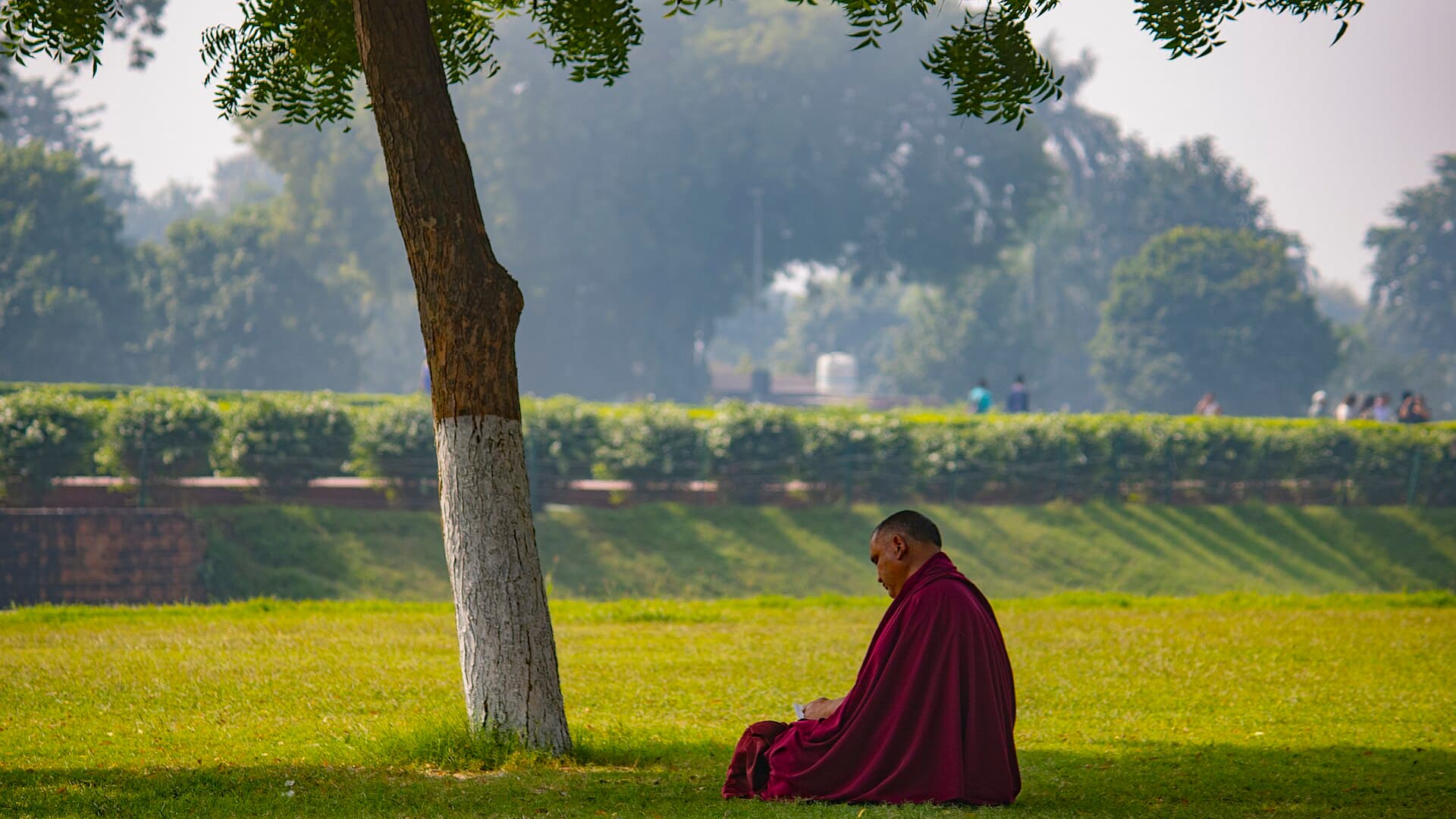
Bodhidharma
First patriarch of Chan/Zen
The historical record of Bodhidharma is thin and the legendary record is enormous, and the gap is itself part of his significance. Daoxuan, the seventh-century Chinese vinaya master, gives the earliest biography in the Continued Biographies of Eminent Monks (Xu gao seng zhuan, c. 645 CE): Bodhidharma was a brahmin from south India, came to China by sea during the Liu Song dynasty (420-479) or possibly the early Liang (502-557), taught two-entrance four-practice meditation, and died in north China after being repeatedly poisoned by jealous rivals. Daoxuan's account is sober and short. The full Chan legend — the meeting with Emperor Wu of Liang, the nine years of wall-gazing at Shaolin, the disciple Huike cutting off his own arm in the snow, the founding of the patriarchal lineage of "twenty-eight patriarchs in India and six in China" — develops over the subsequent four centuries in the Records of the Lankavatara Masters, the Two Entries and Four Practices, the Anthology of the Patriarchal Hall (952), and finally the great compendium of Chan transmission, the Jingde-era Transmission of the Lamp (Jingde chuandeng lu, 1004).
The figure that emerges from these layers is the one the tradition kept. Bodhidharma was, the Transmission of the Lamp records, the third son of a south Indian king, of the brahmin caste. He took ordination under Prajnatara, the twenty-seventh patriarch in the Indian lineage descending from Mahakassapa. Prajnatara, before his death, instructed Bodhidharma to take the dharma to China when the karmic conditions were right. Bodhidharma waited sixty years after his teacher's death, then sailed from south India to Guangzhou around 520 CE, in the third year of the reign of Emperor Wu of Liang.
Emperor Wu — a famously devout Buddhist who had built temples, sponsored translations, and ordained monks in vast numbers — invited Bodhidharma to court at Jiankang (present-day Nanjing). The dialogue that followed is the founding koan of the entire Chan tradition. The emperor asked: "I have built many temples and copied many sutras and supported many monks. How much merit have I accumulated?" Bodhidharma answered: "None." The emperor, surprised, asked: "Then what is the highest meaning of the holy truth?" Bodhidharma: "Vast emptiness, nothing holy." The emperor: "Who is the one standing before me?" Bodhidharma: "I do not know." He left the court, crossed the Yangtze — by tradition, on a single reed — and went north to the Shaolin temple in the Songshan mountains.
“The historical record of Bodhidharma is thin and the legendary record is enormous, and the gap is itself part of his significance.”
There he sat in a cave for nine years facing the wall. The Chinese phrase is biguan — wall-gazing. It is not, in the Chan reading, a metaphor for blank concentration; it is a precise designation of a meditative state in which the mind, like the wall, neither admits nor turns away from anything that appears. A young Chinese monk named Shenguang came to him asking for instruction. Bodhidharma ignored him. Shenguang stood outside the cave through the night, the snow rising to his knees. In the morning, Bodhidharma asked what he wanted. Shenguang said: "Master, my mind is not at peace. I beg you, pacify it." Bodhidharma said: "Bring me your mind, and I will pacify it." Shenguang said: "I have searched for my mind everywhere and cannot find it." Bodhidharma said: "I have pacified it for you." Shenguang awakened in that moment. He took the dharma name Huike — "Wisdom and Possibility" — and became the second patriarch. The Transmission of the Lamp adds that, to demonstrate his sincerity to a teacher who had ignored him for years, Huike cut off his own left arm and offered it. The detail is hagiographic; the legend is what shaped the lineage.

Bodhidharma's teaching is preserved in a short text — the Two Entries and Four Practices (Erru sixing lun) — which is plausibly attributed to him by modern scholarship. The two entries are: by principle (li-ru), the direct intuition that all beings have buddha-nature, obscured only by deluded thinking; and by practice (xing-ru), the four practices of accepting karmic recompense for past wrongs, accommodating circumstances without grasping, seeking nothing, and acting in accordance with the dharma. The four-line summary attributed to him in the later tradition — "a special transmission outside the scriptures; not depending on words and letters; pointing directly at the human mind; seeing one's nature and becoming Buddha" — is not in the Two Entries text and probably postdates Bodhidharma by a century or more. But it is the slogan that defined the Chan tradition for the next fifteen hundred years.
He died, the legend records, after his sixth attempted poisoning. He had transmitted the robe and bowl of his lineage to Huike. His body was buried in the Bear-Ear Mountains. Three years later, a Chinese envoy returning from central Asia met him on the road, carrying one sandal, walking westward. When the envoy reached Luoyang, the emperor ordered the grave opened. Inside was a single sandal. The tradition reads the story as a literal statement: Bodhidharma was not in the grave. The lineage continues from Huike to Sengcan to Daoxin to Hongren to Huineng, the sixth patriarch — and from Huineng, the entire flowering of classical Chan in Tang dynasty China, and from there to Korea, to Japan, to Vietnam, and in the twentieth century to the West. Every zazen practitioner who sits facing the wall sits in continuation of the nine years at Shaolin.
An Interview with Dzongsar Jamyang Khyentse Rinpoche
On practice, lineage, and the question of belief
A Live Conversation
In dialogue with Dzongsar Khyentse Rinpoche
Dharma Discourse — Session III
Kyabje Chokyi Nyima Rinpoche at Ka-Nying
Nepal and the Buddha Dharma — Part I
Dzongsar Jamyang Khyentse Rinpoche in Kathmandu