The Spread to China — The Silk Road
First century CE to the Tang — translators, pilgrims, schools
When Buddhist monks first walked into the Han capital of Luoyang in the first century CE, they came along the Silk Road from the oasis kingdoms of Central Asia — Khotan, Kashgar, Kucha, Turfan — themselves already Buddhist for two or three centuries. The Han chronicle records that the Emperor Mingdi (r. 57–75 CE) dreamt of a golden figure flying through his palace and was told by his advisors that this was the Buddha of the West; he dispatched a mission, which returned in 67 CE with two Indian monks, Kasyapa Matanga and Dharmaratna, the Forty-Two Section Sutra, and a white horse carrying the texts. The White Horse Temple (Baima Si) was built outside Luoyang to house them; it still stands today, the oldest Buddhist temple in China.
The transmission was slow at first, and through translation. The Parthian monk An Shigao arrived in Luoyang around 148 CE and translated dhyana and abhidharma texts. The Yuezhi monk Lokakshema, arriving around 178 CE, translated the first Chinese versions of the Prajnaparamita literature, the Pratyutpanna-samadhi Sutra, and the Aksobhya Buddha sutra. For the next four centuries, an enormous translation enterprise unfolded: the Indian and Central Asian sutras were rendered into Chinese in a sustained effort that has few historical parallels for scale and quality.
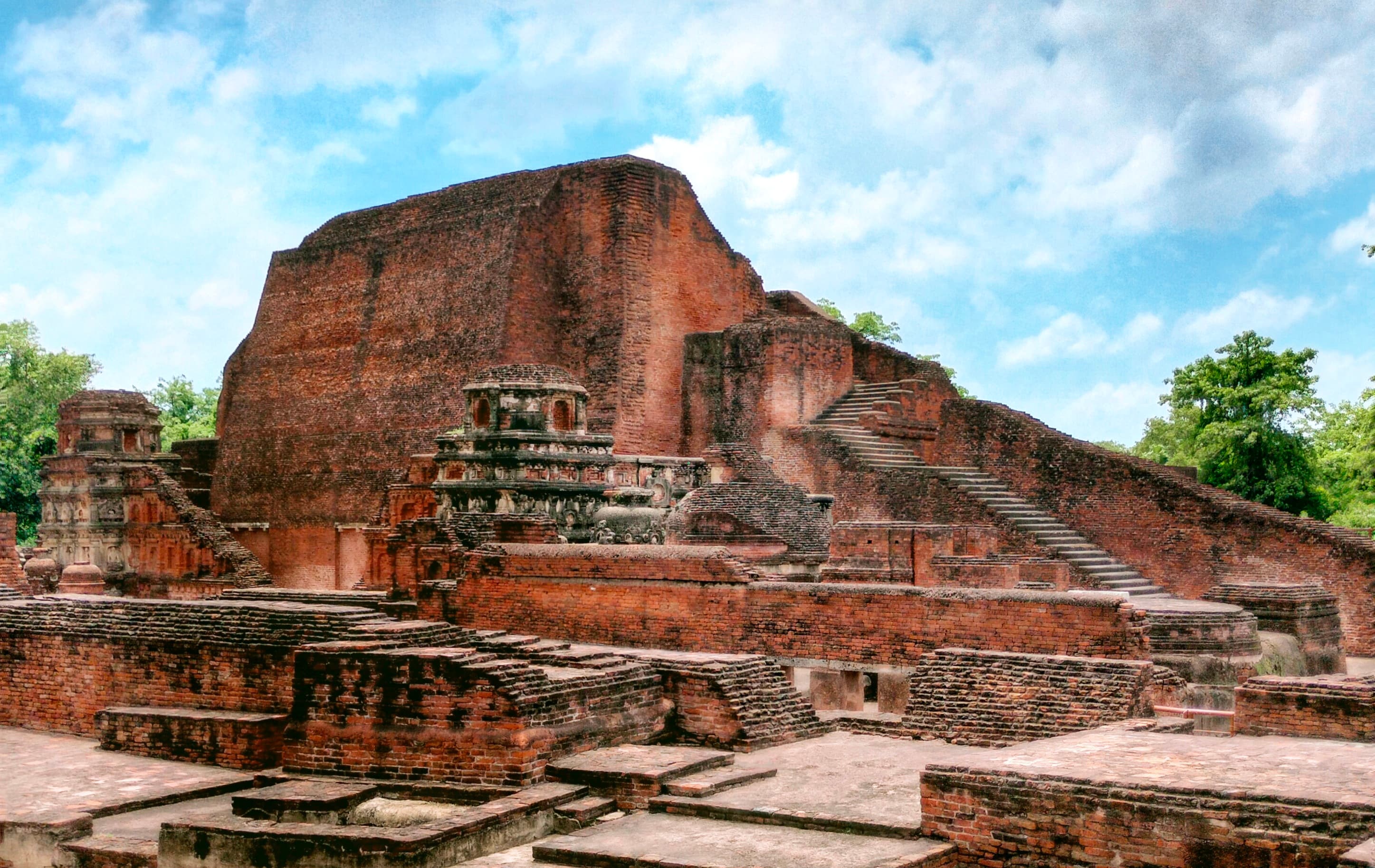
Four figures stand out. Kumarajiva (344–413), a half-Kuchean half-Indian monk captured in 384 by the warlord Lü Guang and finally brought to Chang'an in 401, oversaw a translation bureau of thousands; his translations of the Lotus Sutra, the Diamond Sutra, the Vimalakirti Sutra, and the Madhyamaka treatises of Nagarjuna and Aryadeva became the standard Chinese editions and shaped East Asian Buddhism for fifteen centuries. The Chinese pilgrim-monk Faxian made the journey to India and back between 399 and 414, walking through Central Asia to Pataliputra and returning by sea via Sri Lanka, bringing back the Vinaya, the Mahaparinirvana Sutra, and a record of his travels still consulted as a primary source for late Gupta India. The pilgrim Xuanzang (602–664) made a sixteen-year journey to India between 629 and 645, studied at Nalanda University for years under the abbot Silabhadra, returned to the Tang capital Chang'an with 657 Sanskrit texts on twenty horses, and led a translation enterprise that produced the most precise Chinese versions of the Yogacara corpus, the Heart Sutra, the Great Prajnaparamita Sutra in 600 fascicles, and his own Records of the Western Regions, which Wu Cheng'en's sixteenth-century novel Journey to the West would later fictionalize. Yijing (635–713) made a parallel journey by sea between 671 and 695, studied at Nalanda for over a decade, and brought back the Mulasarvastivada Vinaya along with detailed observations on Indian monastic life.
“The White Horse Temple (Baima Si) was built outside Luoyang to house them; it still stands today, the oldest Buddhist temple in China.”
The Chinese schools crystallized in the Sui and early Tang. Tiantai, founded by Zhiyi (538–597) on Mount Tiantai, organized the entire sutra canon around the Lotus Sutra in a five-period, eight-teaching scheme; its doctrine of ichinen-sanzen — three thousand realms in a single moment of mind — became one of East Asian Buddhism's deepest contributions. Huayan, founded by Dushun (557–640) and systematized by Fazang (643–712), built its philosophy on the Avatamsaka Sutra and the image of Indra's Net — every node a jewel reflecting all others. Sanlun (the Three Treatise school) carried Nagarjuna's Madhyamaka into Chinese soil through Jizang (549–623). Faxiang, founded by Xuanzang and Kuiji, carried Yogacara. Chan, the meditation school, emerged with the Sixth Patriarch Huineng (638–713) and became the most enduring of all. Pure Land coalesced through Tan-luan, Daochuo, and Shan-tao and reached the lay majority. The Vinaya school (Lü) preserved monastic orthodoxy. The Tantric school (Mi or Zhenyan), brought in the eighth century by the Indian masters Subhakarasimha, Vajrabodhi, and Amoghavajra, transmitted the Mahavairocana and Tattvasamgraha tantras; in 804 the Japanese monk Kukai received this transmission in Chang'an and carried it home to found Shingon.

The Tang persecution of 845 under Emperor Wuzong nearly destroyed Buddhism in China; over 4,600 monasteries and 40,000 shrines were closed, and 260,500 monks and nuns were forced back to lay life. The schools that survived were the ones least dependent on imperial patronage — Chan and Pure Land. From the late Tang and Song dynasties forward, these two became the operational mainstream, often combined in single monasteries: 'Chan and Pure Land cultivated together' became a slogan. The Song saw the compilation of the Patriarchs' Hall Anthology, the Jingde Record of the Transmission of the Lamp, and the great koan collections. The Ming and Qing saw renewed translation and synthesis. The Republican period saw the reform movement of Taixu and the rise of Humanistic Buddhism (renjian fojiao) under Yin Shun, which laid the doctrinal foundation for the modern Taiwanese Buddhist organizations — Fo Guang Shan, Dharma Drum Mountain, Tzu Chi, Chung Tai Shan — that now carry the Chinese Mahayana globally.
The Chinese Buddhist canon — over five thousand fascicles in the Taisho edition — is the largest body of Buddhist scripture in any language and contains many texts whose Sanskrit originals are lost. China did not just receive the dharma. It became, for fifteen centuries, its largest archive.
In Conversation with Venerable Miao Ru
A TPS Studio dispatch
Courage to Come Home
Br. Bao Tang — Plum Village tradition
Grief and Loss: A Sacred Doorway
Sr. Dao Nghiem — Plum Village tradition
Neuroscience Meets Buddhist Psychology | Joann Rosen & Yousef Gaber
Plum Village monastic, in the Thich Nhat Hanh tradition
