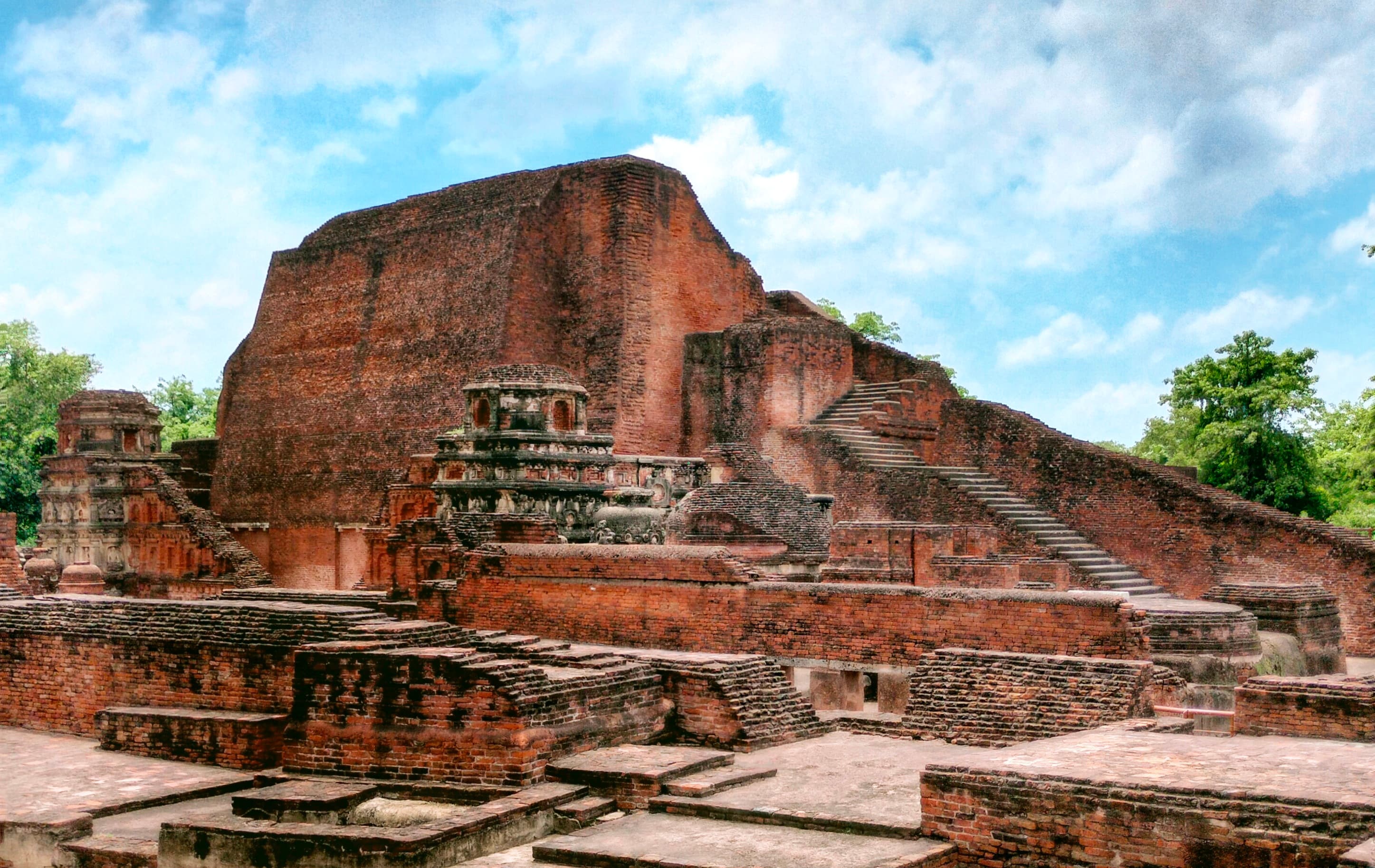
The First Buddhist Council
Rajgir, c. 483 BCE — the canon takes form
Three months after the Buddha's parinirvana at Kushinagar in 483 BCE (or 400 BCE in the revised dating now favored by many scholars), the elder Mahakassapa — convinced that without an authoritative recitation the dharma would scatter and decay — convened five hundred fully ordained arahants in the Sattapanni Cave at Rajagriha (modern Rajgir). The patron was King Ajatasattu of Magadha, who had built the seven-roofed pavilion in front of the cave to house the assembly. The first rains retreat after the Buddha's death was given over to the recitation. This is the First Buddhist Council, and it is the moment at which the dharma becomes a canon.
The account is preserved in the Cullavagga, the eleventh and twelfth chapters of the Vinaya Pitaka, with parallels in the Mahasamghika and Sarvastivada vinayas. The structure was simple. Mahakassapa, as the most senior arahant, took the chair. Upali, who had been the Buddha's foremost expert on the rule, was questioned about the Vinaya — every monastic precept was recited, with the case that occasioned it, the precept itself, the gradual amendments, and the relevant explanations. Then Ananda, the Buddha's personal attendant for the last twenty-five years of his life and the one who had heard more discourses than anyone alive, was questioned about the Dhamma — every sutta was recited as he remembered it, in the formula 'Thus have I heard, on one occasion the Blessed One was staying at…' The collected suttas were divided into the five Nikayas (Digha, Majjhima, Samyutta, Anguttara, Khuddaka) and committed to communal memorization by lineages of bhanakas — reciters — each of whom specialized in one or more collections. The Abhidhamma was either also recited at this council (the Theravada view) or developed later (the broader scholarly view).
Three moments at the council have left long shadows. The first is the case of Ananda himself. Mahakassapa initially excluded Ananda from the assembly on the grounds that he was not yet an arahant, only a stream-enterer. Ananda meditated through the night and attained arahantship just before dawn, entering the council as the assembly reconvened. The textual tradition then records that he was reprimanded — gently, but reprimanded — on five accounts: that he had not asked the Buddha to live out the full kalpa, that he had been careless about the lesser and minor rules the Buddha had said could be relaxed, that he had stepped on the Buddha's robe, that he had let women see the Buddha's body at the cremation, and most consequentially that he had pressed for the ordination of women, including Mahaprajapati Gotami the Buddha's aunt and stepmother. Ananda accepted each charge while noting the contexts. The Theravada tradition has read these as faults; modern feminist readings have re-read them as marks of moral courage on Ananda's part.
“The patron was King Ajatasattu of Magadha, who had built the seven-roofed pavilion in front of the cave to house the assembly.”
The second long shadow is the episode of Purana. Purana, a senior monk, arrived at Rajagriha after the council had concluded its recitation and was invited to confirm what had been agreed. He famously declined, saying, 'Friends, the Dhamma and Vinaya have been well chanted by the elders. Nevertheless, I will hold to it just as I heard it from the Blessed One's own mouth.' This polite dissent — registered in the Cullavagga — is the first evidence in Buddhist history that even at the original council, there were already differences of memory and practice across the dispersed sangha. The council produced a standard; it could not produce uniformity.

The third moment is the question of the minor rules. The Buddha had told Ananda before his death that the Sangha could abolish the lesser and minor precepts if it wished. Ananda had not asked the Buddha to specify which precepts these were. The council debated, could not agree, and resolved to leave every precept intact. The conservatism that would define the Theravada is already present at this first assembly.
What the First Council produced was not yet a written canon. The Pali was committed to writing only at Aluvihare in Sri Lanka in 29 BCE, nearly four centuries later. What it produced was an oral architecture — the five Nikayas, the Vinaya, the case-and-precept structure, the bhanaka lineages — sufficient to carry the Buddha's words across those four centuries with remarkable fidelity. The internal consistency of the early Pali texts, when compared with the parallel Chinese Agamas translated from Sanskrit and Prakrit originals, suggests that the council's work held. The dharma did not scatter. It became a canon.
How to Free Oneself from Depression
Vassa Discourse · Day 1 · Rajkiya Buddha Vihara, Lumbini
The Means to End Suffering
Vassa Discourse · Day 2 · Rajkiya Buddha Vihara, Lumbini
The Means to End Suffering — Day 3
Vassa Discourse · Rajkiya Buddha Vihara, Lumbini
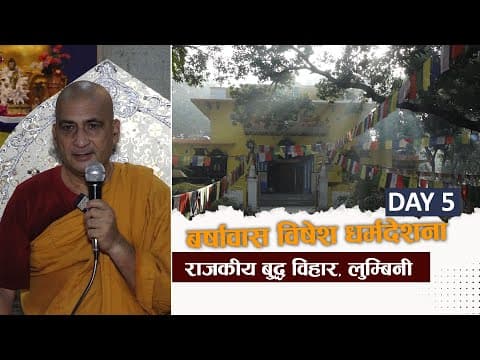
Holding Suffering in a Positive Light
Vassa Discourse · Day 5 · Rajkiya Buddha Vihara, Lumbini

