
The Dharma Wheel (Dharmachakra)
Eight spokes, one path
When the Buddha gave his first teaching at the Deer Park in Sarnath to the five ascetics, the text describes the moment with a particular metaphor: he 'set in motion the supreme Wheel of the Dhamma' — dhammacakkam pavattetva. The wheel was a Vedic image, an ancient symbol of cosmic order and royal authority — the chakravartin, the 'wheel-turning king,' was the universal monarch. The Buddha appropriated the image and gave it a new meaning. The wheel he set in motion was the dharma; the kingdom it would rule was the kingdom of awakening.
The dharmachakra has been the central Buddhist symbol from the earliest period. In the aniconic art of the first three centuries after the Buddha's death — Bharhut, Sanchi, Amaravati — when the Buddha himself was not represented in human form, his presence was indicated by symbols: the empty throne, the footprints, the bodhi tree, and above all the dharma wheel. To see a wheel on the lintel of an early Buddhist gateway is to see, in the iconographic shorthand of the period, the Buddha teaching.
The canonical form is eight-spoked. The eight spokes represent the eight limbs of the Noble Eightfold Path: right view, right intention, right speech, right action, right livelihood, right effort, right mindfulness, right concentration. The rim is sila — moral discipline — which contains and protects the practice. The hub is samadhi — meditative concentration — from which all motion originates. The whole wheel turns: the dharma is not static but in motion, transmitted from teacher to student across the centuries.
“The wheel was a Vedic image, an ancient symbol of cosmic order and royal authority — the chakravartin, the 'wheel-turning king,' was the universal monarch.”
Other wheel forms appear in regional traditions. The four-spoked wheel of early Sri Lankan and Burmese art represents the four noble truths. The twelve-spoked wheel represents the twelve links of dependent origination. The thousand-spoked wheel, in the Tibetan and Newar traditions, represents the inexhaustible activity of the dharma.

The Ashokan lion capital, recovered from Sarnath in 1904, carries the wheel as a central element: four lions facing the cardinal directions, mounted on a circular abacus bearing four dharma wheels and four animals (elephant, bull, horse, lion). This capital, depicted on the Indian flag and the seal of the Republic of India, is perhaps the most-reproduced single Buddhist artifact in history. The wheel on the Indian flag is the Buddha's wheel.
The Promised Studios' own mark is the eight-spoke dharma wheel. The choice is deliberate. The logomark is not a wordmark or a stylized monogram — it is the same symbol the Buddha set in motion at Sarnath in 528 BCE.
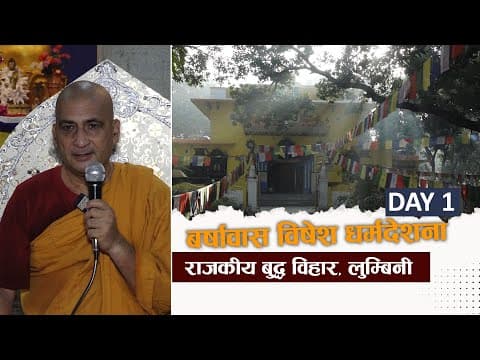
How to Free Oneself from Depression
Vassa Discourse · Day 1 · Rajkiya Buddha Vihara, Lumbini
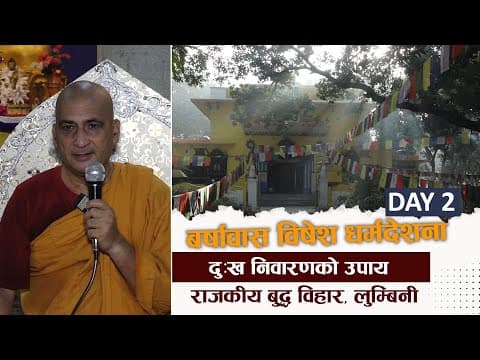
The Means to End Suffering
Vassa Discourse · Day 2 · Rajkiya Buddha Vihara, Lumbini
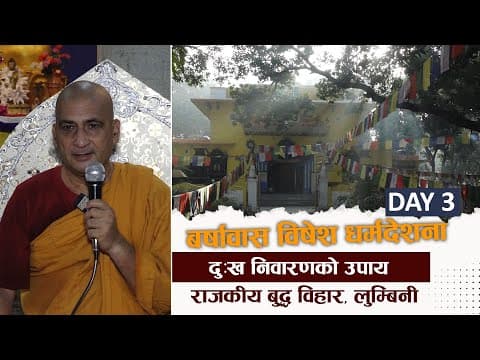
The Means to End Suffering — Day 3
Vassa Discourse · Rajkiya Buddha Vihara, Lumbini
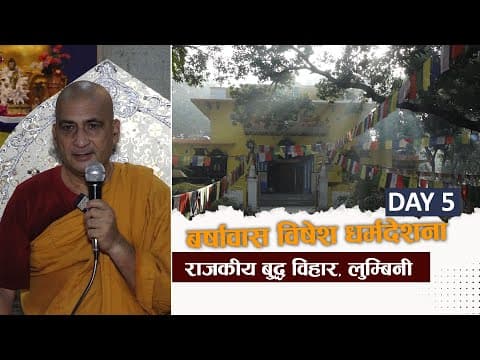
Holding Suffering in a Positive Light
Vassa Discourse · Day 5 · Rajkiya Buddha Vihara, Lumbini
